
As the new federal administration sets its sights on boosting manufacturing in the United States, a question arises: Where will the additional workforce for those manufacturing jobs come from and will Americans find those jobs attractive enough to pursue?
A new study reveals that not only are manufacturing jobs highly rated by employees, but the opportunities for technically skilled workers in manufacturing are also growing.
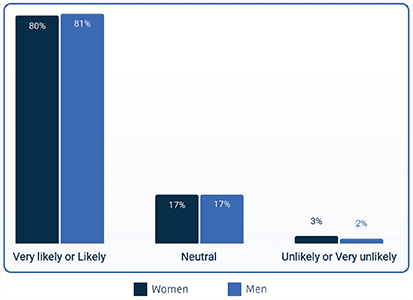
The study, “2025 Career Advancement in Manufacturing Report,” was published by the Women in Manufacturing Association, or WiM, a nonprofit global trade association working to advance women in the manufacturing sector, in partnership with Xometry, an industrial custom parts manufacturer. It states that 80% of women and 81% of men recommend a manufacturing career.
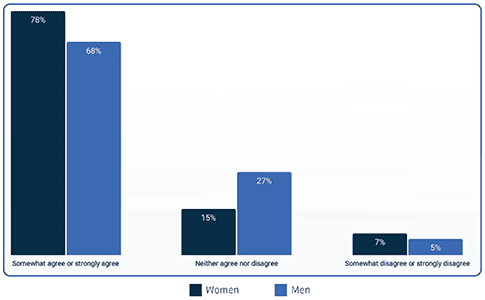
The study also notes that 78% of women believe significant progress has been made for women in manufacturing in the past five years and are optimistic about the progress. And though 79% of companies reported experiencing labor shortages, that percentage was a slight decrease from 2024, suggesting potential improvement and a continuing need for manufacturing workers.
How likely are you to recommend a career in manufacturing?
The report also reveals that 70% of manufacturing industry professionals enter the space unintentionally, with 74% of women and 49% of men “falling into” manufacturing careers. Most people enter manufacturing through job postings, referrals, recruitment, STEM programs, and apprenticeships or internships.
“Manufacturing can be a dynamic and rewarding field for women,” says Allison Grealis, president and founder of WiM. “We’ve made incredible strides in bringing more women into the industry, but our mission is to ensure they’re not just stumbling upon these careers by chance. Businesses and universities are now taking deliberate steps to introduce women to manufacturing roles, which marks a meaningful shift for the future of the field.”
The report includes quotes from survey respondents, who suggest that there are several ways to recruit more women into manufacturing. These include intentionally reaching out to young women in high school and college, promoting the variety of roles available in manufacturing — such as quality engineer, maintenance technician, and production operator — and highlighting such benefits as earnings, advancement potential, and job flexibility.
“Given the skills gap and the number of manufacturing positions that we must fill, which right now ranks higher than half a million open jobs, we must look at the full population for recruitment,” Grealis says.
“The manufacturing landscape is transforming,” she adds. “AI, automation, and smart manufacturing are redefining modern facilities. Once mundane or repetitive, jobs are now intertwined with advanced technology, creating exciting opportunities for upskilling and career growth.”
The survey’s forecast of what manufacturing will look like in 2030 includes some significant shifts in the industry:
- Increased automation and robotics for efficiency, precision, and addressing labor shortages
- Increased need for AI skills
- Increased need for additional technical skills to work with complex machinery and digital systems, requiring upskilling and reskilling of the workforce
- Increased adoption of technologies like the Internet of Things, digital twins, and advanced data analytics because of the digital transformation facilitated by connected systems
Do you agree or disagree with the following statement: Women have made significant progress in the manufacturing industry over the last five years.
“Companies are embracing technology to help with training, production, and quality,” Grealis says. “I’ve seen companies using a tool like Google Glass. Those who are working within an assembly line can get real-time work instructions directly through their eyewear.
“New technologies can now scan finished products to detect defects,” she adds. “It’s exciting to see how adopting these advancements will continue to transform manufacturing offerings.”
WiM aims to expose more people to manufacturing careers and positively impact the perception of manufacturing globally. One initiative is the Hear Her Story podcast, which Grealis hosts. Another is programming produced by the association’s 34 local chapters, which are on track to develop more than 400 programs this year. WiM’s Virtual Learning Series also offers more than 100 hours of training that is searchable by subject matter or expert, and starting this year, natural language selection is available for non-English speakers. In 2023, WiM began hosting international events, with one in Monterrey, Mexico, earlier this year, Milan in June, and more planned.
“These are great opportunities to expand WiM beyond the U.S., reaching regions that lack the same level of inclusion, support, and professional development for women,” Grealis says. “When I visited Mexico, it was clear their needs closely resembled where our U.S. members were a decade ago. There’s a strong demand for us to foster networking, mentoring, and relationship building to drive progress.”
Allison Grealis, founder and president of Women in Manufacturing, sits down with SWE CEO and Executive Director Karen Horting to discuss the state of women in manufacturing for DIVERSE, A SWE podcast. Find episode 310 at podcast.swe.org or click below to listen.
Like the Society of Women Engineers, WiM seeks to provide resources and communities to women outside of their own companies. The organization works with close to 550 corporate members who are aligned with its mission of supporting, promoting, and inspiring women in manufacturing and committed to attracting, retaining, and advancing diverse talent.
WiM hosts several programs throughout the year to augment its efforts, including the SUMMIT, its largest annual gathering. This year’s event will be held Oct. 12-14 at McCormick Place in Chicago.
The association will launch a formal mentorship program across its chapters by year’s end and offer coaching support next. WiM’s latest program focuses on allyship. Its first Men as Allies conference, hosted recently, gathered nearly 70 men in executive positions to learn how to have more impact as an ally, advance women’s talent, and be a supportive coach, advocate, and mentor.
WiM is celebrating its 15th anniversary this year. WiM has partnered with SWE for this occasion so members of both organizations can access reciprocal discounts and joint member benefits for attending in-person and virtual programming. The organization has a membership of 32,000 from every U.S. state and more than 70 countries. It offers a hybrid membership model with corporate, individual, student, and retired members options.
To receive the promotional code for WiM membership, SWE members should email membership@swe.org.