


The gender gap in the science, technology, engineering, and mathematics, or STEM, achievement in secondary school continues across the globe, even among high achievers, according to new research from the Organisation for Economic Co-operation Development, or OECD.¹ Prior research has established that top-performing secondary school students are more likely to pursue math or science in postsecondary education. So, it is essential to understand what the scores of these students tell us about the gender gap in science and math if we want to increase the representation of women in STEM in higher education.
The OECD typically conducts a study called Programme International Student Assessment, or PISA, every three years. PISA evaluates the mathematics and science literacy of 15-year-old students across the world through two-hour computer-based tests. Results from the 2022 survey were recently released and show some troubling trends.
Figure 1: Gender Differences (calculated as boys–girls) in PISA 90th Percentile Math Scores in 2012-2022
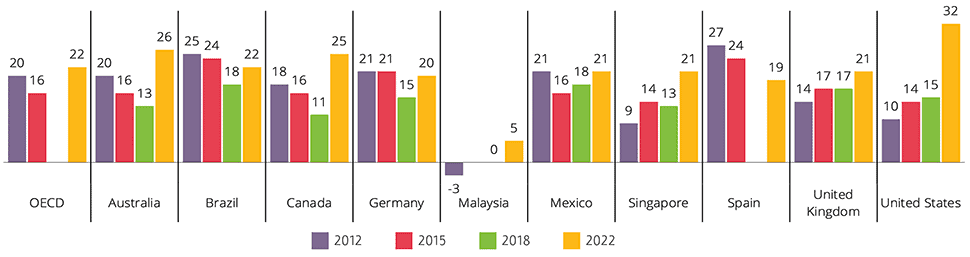
The OECD examined the gender differences in students scoring in the 90th percentile on the PISA tests. The charts found here show findings between 2012 and 2022 in the United States and select other countries. The U.S. had more than 5,500 students and 154 schools participating in the PISA in 2022. The charts show the gender differences; the number is calculated as boys minus girls, with a higher number indicating a wider gender gap in favor of boys.
As shown in figure 1, the U.S. had the largest gender differences in math scores, with girls scoring 32 points lower than boys in 2022. The gender gap in math in the U.S. has widened progressively from 2012, when there was only a 10-point difference. Boys also consistently outperformed girls in math across the other countries between 2012 and 2022, except in Malaysia. There, in 2012, girls out-performed boys by 3 points, though they were back to a five-point deficit by 2022.
Figure 2: Gender Differences (calculated as boys–girls) in PISA 90th Percentile Science Scores in 2012-2022
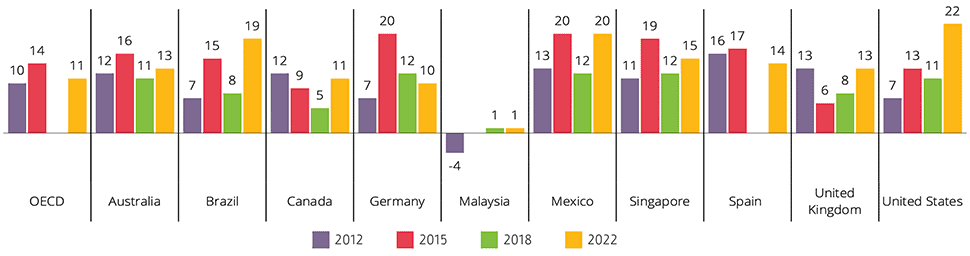
When measuring science scores, the largest gender difference was also found in the U.S. (22 points), as shown in figure 2. And as with math, boys also consistently outperformed girls in science across the other countries between 2012 and 2022, except in Malaysia in 2012, when girls scored 4 points higher.
Socieconomic significance
The gender gap in math among those in the bottom quarter of PISA’s economic, social, and cultural status, or ESCS, category was between 6 and 21 points in favor of boys in 2022, except in Malaysia, where girls outperformed boys by 6 points (see figure 3). Among the top quarter of the ESCS, gaps of 7 to 29 points were observed, with girls consistently scoring lower than boys across all countries except for Malaysia, which had no gender difference.
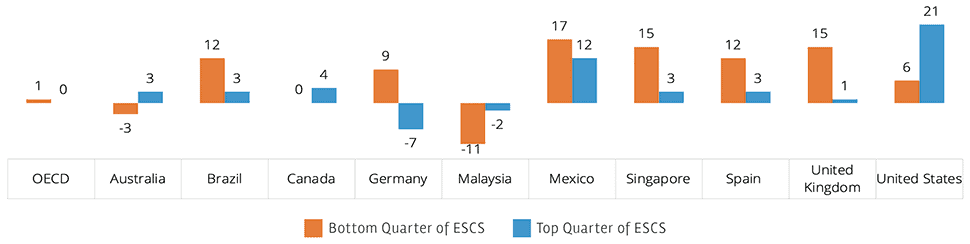
The gender gap in science among the bottom quarter of PISA’s ESCS was between 1 and 17 points in favor of boys in 2022, except in Canada, where there were no gender differences, and in Australia and Malaysia (figure 4). Girls outperformed boys in science by 3 points in Australia and by 11 points in Malaysia.
Figure 3: Gender Differences (calculated as boys–girls) in PISA Mathematics Performance by Socioeconomic Status in 2022
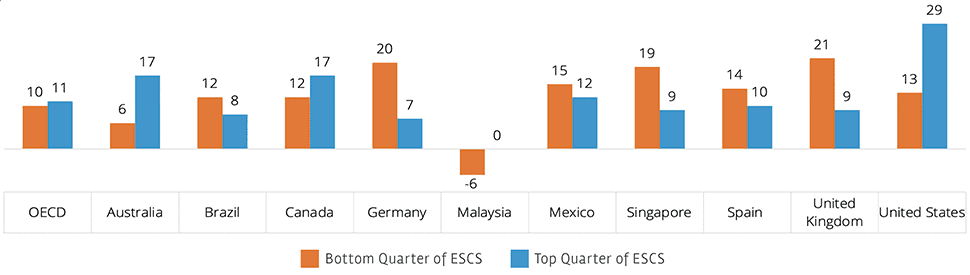
Among the top quarter of the ESCS, gaps of 1 to 21 points were observed in science, with girls scoring lower than boys across all countries except for Germany and Malaysia. In Germany, girls in this top ESCS group outperformed boys by 7 points; in Malaysia, it was 2 points.
Conclusion
This analysis finds that gender differences in science and math performance, even among those who are top-performing students, continue to exist, and the gap is widening over time in many countries. Additionally, the gender differences vary by socioeconomic status in favor of boys across several countries.
Additional research on gender differences in math and science achievement is needed to inform policy and practice related to STEM because these groups continue to be underrepresented in STEM higher education.
Figure 4: Gender Differences (calculated as boys–girls) in PISA Science Performance by Socioeconomic Status in 2022
1 Halpern, D. F., Benbow, C. P., Geary, D. C., Gur, R. C., Hyde, J. S., & Gernsbacher, M. A. (2007). The Science of Sex Differences in Science and Mathematics. Psychological Science in the Public Interest, 8(1), 1-51.