

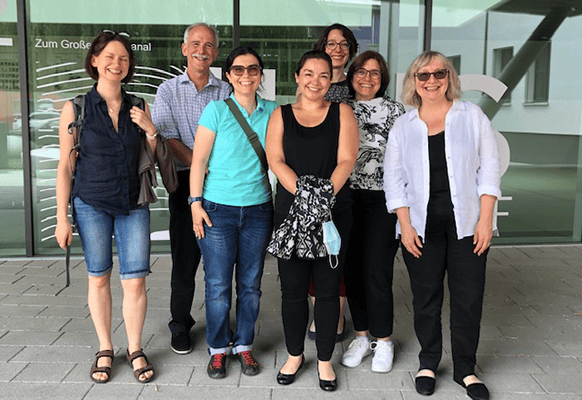
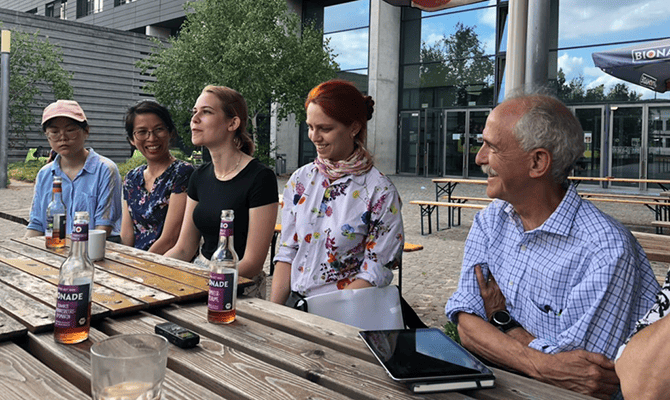
Returning to Berlin, the site of SWE’s initial Europe/United States research roundtable, participants met in early July 2022 on the Campus Adlershof of Humboldt University. Joining some of the original group from 2019 were Humboldt’s program manager for women in natural sciences, as well as a technical director from another German university. Several researchers and program coordinators from institutions in Germany, Austria, and the U.K. were forced to cancel due to COVID-19 but participated in a virtual follow-up.
The July discussion covered a range of topics including bias, stereotypes, culture/climate, and unequal treatment of women in STEM in both academia and industry and efforts to address these issues. The discussion was divided into three main areas, with key takeaways summarized below.
Question One: Are initiatives to increase women’s representation in STEM working? They are well meant, but can we figure out how to do it better?
Citing personal experience, observation, and limited data, roundtable participants agreed that a lack of accountability and transparency make it difficult to discern which initiatives work or whether they can be sustained or replicated. Many efforts are personality driven, that is to say, a program may be effective if that individual is there to champion it and ensure that appropriate funding and institutional supports are present and maintained.
The general environment outside of a well-intended initiative is frequently not considered during the planning process. Programs meant to help may be designed in such ways that critical structures — such as child care, flexible hours, or family leave — are not given the weight or understanding required of real-life situations. For example, a mentoring program for women scheduled when it is time to pick up children from school or day care does not help women with young children. In another scenario, important departmental meetings that take place late in the day when mothers (typically it is mothers rather than fathers) pick up their children. In terms of family leave, research in the United States has shown that in academic settings, fathers took parental leave and used that time to submit papers for publication, while mothers took care of the new baby. This set an unreasonable expectation, in some instances, that mothers on family leave would also publish journal articles while taking care of a new baby.
Ignoring these realities reflects larger societal issues and assumptions concerning gender roles. As one participant said: “Indeed, I think the problem is really broader. And it’s really a problem of the whole society.”
It was noted that efforts to support women in STEM, both in academia and industry, are sometimes a matter of checking a box rather than a serious attempt to increase participation and retention. For women in academia, a consequence of the “check the box” approach may mean that the lone woman in a department must participate in all committees — because committees require gender diversity — placing an undue and uncompensated burden on her. In industry, merely checking a box translates into “window dressing” rather than committing resources to analyze and solve problems.
While results of many well-intended efforts are deemed piecemeal at best, there are pockets of success. In the United States, the National Science Foundation’s ADVANCE program for institutional transformation was offered as one example, though success rates may vary from university to university. The program is well funded, requires institutional buy-in at the highest levels, and is sustained over a several-year period. Accountability and metrics are built in, and a major component of the program is changing institutional policies and procedures to increase the representation, diversity, and advancement of women in academic science and engineering careers. In the U.K., the Athena Swan Charter, a program that evaluates and ranks university programs, is another example. While still in its early stages, a mentoring program at Humboldt is another promising example.
Recommendations/insights include:
- A more holistic approach is needed when developing programs and initiatives.
- Use of metrics and data to ascertain programs’ effectiveness.
- Shifting the perspectives of the deans / management / leadership level of universities and companies.
- Providing actual resources to drive these initiatives further.
“…In a broader perspective, we need more data about how these programs work. But at our level at university, I can see the progress. I am here since 2017. I developed this program, and I started with a survey. It was really a tailor-made program. We are not only targeting problems like female encouragement, but also yesterday, for instance, it was a classical workshop in presentational skills. I was there for the feedback … someone from physics said, ‘Well, it was really a change of perspective. Before I always, when I was talking, I had the impression that I have to thank the audience that they listened. And now, after this workshop, I feel that I deserve this place to talk.’ I thought this is a really good point. And, of course, this is just one single person. But for me, it’s better to start with a smaller group, and then you develop something.”
—Petra Metz, Ph.D., program manager, Women in Natural Sciences (WiNS) Adlershof, Humboldt University of Berlin
“ [Having] clear focus — I think that this is a good practice, and that if we try to do everything, and solve everything, it just doesn’t work. The problem is big. It’s complex. And without taking that focus, it’s difficult to really accomplish anything in real time.”
—Rishelle Wimmer, M.A., senior lecturer, information technology and systems management, Salzburg University of Applied Sciences
Question Two: What is your perspective on the paradigm shift that we have observed, from a focus on gender issues to one on diversity issues? Have you seen a backlash to efforts to increase diversity, equity, and inclusion in STEM? If so, are there ways to combat this backlash?
The language and discourse surrounding diversity continues to evolve. New terminologies and concepts, such as the addition of belonging (diversity, equity, inclusion, and belonging, or DEI & B) is but one example. Our collective understanding and awareness are both expanding and at the same time becoming more fractured. The increased focus on transgender issues has also raised new questions that have become politicized. Given the increasingly high stakes nature of public discussions on diversity, identity politics, public shaming, and the like, it is becoming even more difficult to design programs that are both constructive and inclusive.
There was strong consensus on the value of an intersectional lens. It is important to understand that one may be a woman engineer or scientist, but also gay, or Black, or an immigrant, and recognize that individuals are dealing with discrimination and related issues on many different levels.
Yet, at the same time, grouping varied issues together under one banner of diversity may dilute gender equity and other concerns. Depending upon the profile, personality, and focus of the person in charge of diversity initiatives at an institution or company, it is likely that one aspect of diversity takes precedence at the expense of others.
In situations with limited resources and/or a questionable level of commitment on the part of upper management, gender equity programs may be eliminated before they have had time to prove their effectiveness and be replaced with the latest trend to “look good.” Referencing the previous discussion, substituting glitz for substance (and the time it takes to develop an effective program with substance) does not serve anyone.
One participant noted that we are “in an acute phase” toward making the working environment and the whole of society more inclusive. Therefore, taking a “bird’s eye view” provides perspective and insight.
Recommendations/insights Include:
- Because examining how to pursue gender equity initiatives within a broader set of diversity initiatives is a complex topic, it merits an entire workshop or conference session.
- We must be careful that gender equity programs and initiatives are not eliminated under the banner of broader diversity initiatives.
- It is useful to convey that a benefit or accommodation for one group may benefit all. For example, curb cuts benefit more than people using wheelchairs.
- In allocating time and resources, remember it is not possible to be all things to all people.
- Under the umbrella of intersectionality, we recognize that people may be dealing with discrimination on any number of levels.
“When they say, we need to implement more measures when the measures for women are not yet implemented, I’m feeling like they just abandoned those to try the new stuff.”
—Vita Solovyeva, Ph.D., technical director, Electron and Light Microscopy Service Unit, Carl von Ossietzky University of Oldenburg
“It’s fighting for belonging and acceptance, which is where this belonging in the hierarchy of needs comes from. And the question is, ‘If I do something good, that’s going to be good for everybody …’ So, from the aspect of people with disabilities, then if I have a curb cut for people in wheelchairs so that they can get across the street, it benefits bicycle riders, benefits people who have a pram.”
—Rishelle Wimmer, M.A., senior lecturer, information technology and systems management, Salzburg University of Applied Sciences
“The best response is not to fight the small fight, but rather to try to make the whole society and the whole working environment more inclusive, whatever the inclusion is all about. Because I think this is still a sort of aftermath of the society being dominated by one type, which is the Caucasian male.”
—Caterina Cocchi, Ph.D., full professor, physics, Carl von Ossietzky University of Oldenburg
“At our university, the diversity officer typically would be African American, usually male. And so this raised all kinds of issues about what’s the priority. The women’s issues tended to disappear completely, and then there was a real tension between Black and Hispanic people, because, as opposed to Austin, Latinos are a very small percentage of the student population and the faculty. In Cleveland, African Americans are a very large group. And so that took all the oxygen out of the room and that became the priority. Women and Latinos felt left out, and I’m sure in other contexts, it’s the reverse — that in a context where Latinos are the majority, do Black voices get heard? Are women’s voices, women’s issues raised in a way that speaks to non-Latino women?”
—Peter F. Meiksins, Ph.D., emeritus professor of sociology, Cleveland State University, lead author of the annual SWE Literature Review
Question Three: Are there topics that researchers have overlooked when it comes to increasing diversity, equity, and inclusion in STEM?
For the past 11 years, if not longer, the annual SWE Literature Review published in SWE Magazine has called for more research on women engineers in industry. Exactly why there is so little research in this area and what can be done to promote this type of research occupied a great deal of the discussion.
Indeed, this is an area that researchers have not been able to explore other than on a very limited basis. Unlike the academic world where there is research funding, greater transparency, and sharing of information, corporations remain largely inaccessible. When corporations do allow research or assessments, it is with an eye toward the bottom line and the results are proprietary. They are shared with the public on the corporation’s terms — that is, if the results position them in a favorable light.
Many insights regarding employment practices in large tech firms come from personal essays, op-eds, news articles featuring interviews with women who have left those firms, or from books former female employees have written. These detail individual women’s experiences of harassment and bias, of company policies that are either inadequate to address these problems or function as window dressing and are, therefore, unenforced. These personal exposés are revealing but not a substitute for social science research.
“Best Places to Work” surveys published in the popular press lack the rigor of social science research as well. Organizations such as Catalyst may perform valuable research on individual companies, but the results remain largely with those companies. The International Labour Organization conducts research and reports its findings, but these are large data sets that do not drill down into specific policies or corporate culture. SWE’s own culture study obtained data from SWE members rather than companies, making it possible to publish and present data and insights that might not have been otherwise known.
Suggestions on how to garner company participation in research efforts ranged from developing a program where peer mentoring between companies takes place in exchange for participating, or the promise of analysis and interpretation of data with counseling and resources for areas that need improvement, to adopting a model similar to the NSF ADVANCE program in universities, or the Athena Swan program in the U.K., which is also applied to universities and research institutions. While universities have an enticement to participate, such as NSF funding in the United States, industry has no equivalent.
The discussion on companies and hiring practices raised issues pertinent to academia, where speaking and presenting at scientific/technical conferences is a significant aspect of career development and promotion. Teasing apart the reasons for women’s low participation, the importance of providing child care at conferences, the crucial role of encouragement from professors or managers to submit abstracts to conference organizers, and the need for conference organizers to expand their networks to be more inclusive were cited. Roundtable participants agreed that “fixing the system” in these ways would be more effective than “fixing the women” by merely pushing them to submit abstracts.
Coming full circle, the final roundtable question led the group back to the first question: “Are initiatives to increase women’s representation in STEM working? They are well meant, but can we figure out how to do it better?” The answers to the first and the final questions are closely related, as it turns out, and solutions are intertwined.
Indeed, solutions to the underrepresentation of women in engineering, including pipeline issues on STEM pathways as well as retention issues in academia and industry, require commitment, research, dedicated resources, and intentionality by institutions and employers. The roundtable participants concluded by acknowledging the many commonalities, as well as some of the differences, between the European and American experiences and expressing appreciation for the opportunity to discuss them at length.
Recommendations/insights include:
- Discover new ways to encourage companies to engage with researchers so that findings can be used to develop appropriate solutions and may be shared either through peer mentoring or a similar avenue.
- Focus on fixing the system rather than fixing the women.
- Programs that have been successful in academia may serve as models for industry, with some adaption.
“Doing a study of a single company, or getting access to people through companies, is harder than sending a survey to individual engineers who work at various places. You must get the company to agree, and they are reluctant — afraid of bad publicity, secrets getting out, and so on. They may also ask to own the results of the study, and employees may be affected by knowing that the employer gave out their name and knows they are being interviewed.”
—Peter F. Meiksins, Ph.D., emeritus professor of sociology, Cleveland State University, lead author of the annual SWE Literature Review
“You can say you have all these programs in place, but they don’t know who’s using them. They don’t know the impact of utilizing family leave on career advancement, which as we know from the research is one of the big issues that women face. That’s the kind of question that needs to be addressed.”
—Roberta Rincon, Ph.D., SWE associate director of research