


Women coffee growers, producers, logistics engineers, and systems engineers are integral to leaps in technology, accessibility, and manufacturing that will soon let coffee lovers:
- Enjoy a wider array of sustainably produced specialty coffees that follow the rule of fair trade.
- Trace and track their coffee’s origins through blockchain.
- Tip the grower of their favorite brew’s beans with a mouse click.
- Make an instant frozen coffee treat from recyclable pods.
These developments show progress in the global coffee marketplace, a historically male-dominated market that generates a yearly revenue estimated by S&P Global at more than $200 billion.
Women’s growing influence is significant because women make up 70% of the coffee fieldworkers and harvesters in 15 coffee-producing countries, yet participate in only 10% of the trading and export roles, according to the International Coffee Organization, a London-based intergovernmental organization whose five-year plan aims to reduce poverty in developing countries and establish a sustainable, inclusive, and resilient global coffee market.
Supply side
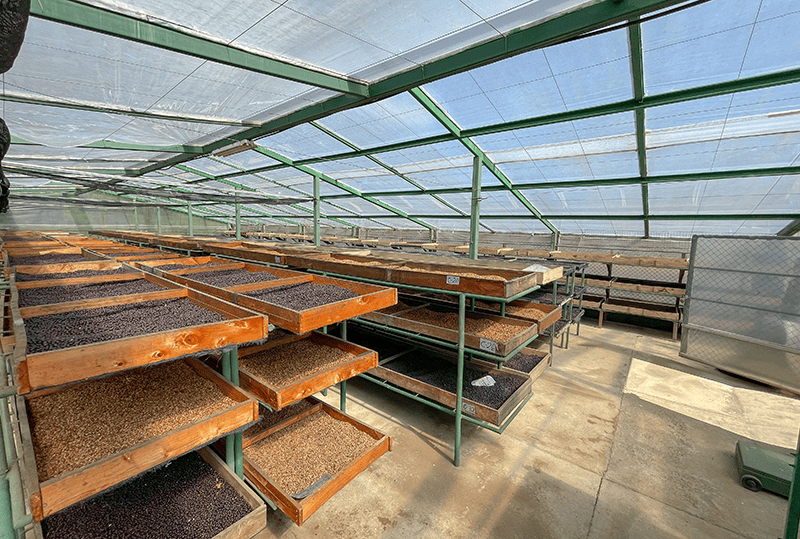
The coffee supply chain starts with the growers, which can range from large plantations to cooperative groups to small family farms. There can be just a few or many links between the growers and the final customers, such as traders, processors, brokers, exporters, roasters, and retailers. While some coffee is grown in California, Hawaii, and Puerto Rico, most is grown in Brazil, Vietnam, Colombia, Indonesia, Ethiopia, and Honduras.
Alina Bartley, a supply chain director with the consultancy Alvarez & Marsal, graduated from the University of Florida with a bachelor of science degree in chemical engineering and from The University of Texas at Austin with an MBA. She has 10 years of experience in manufacturing, procurement, and supply chain management and has helped clients with sourcing and procurement across a wide variety of industries and commodities. She said, “Since COVID-19, there have been many disruptions to these supply chains, which were seen across other commodity markets, too, in the form of logistical challenges, trade restrictions, labor shortages, and specifically for the coffee bean market, adverse weather events affecting production in some countries, notably Brazil, the ‘coffee pot of the world.’” Among the logistical challenges, she said, were increased transportation costs, reduced port availability, and reduced availability of shipping containers for imports.
The Ukraine-Russia war further affected coffee bean production by contributing to extremely high fertilizer prices, Bartley said. And Colombia, the United States’ second-largest coffee supplier and the world’s third largest, faced a port lockdown in 2021 at its largest port for coffee exports — Buenaventura — due to strikes, she noted.
“This led to massive supply-side bottlenecks as less coffee was being produced, and less coffee could be effectively exported or imported into the demand-side markets,” she said. “As consumers, we saw these effects in the form of rising coffee prices.”

“It helps to keep up in case I ever have to switch gears and find a new opportunity that sounds exciting. If I wasn’t up to speed, I might not have the skills to pursue that opportunity. And that would be a missed chance.”
— Alina Bartley
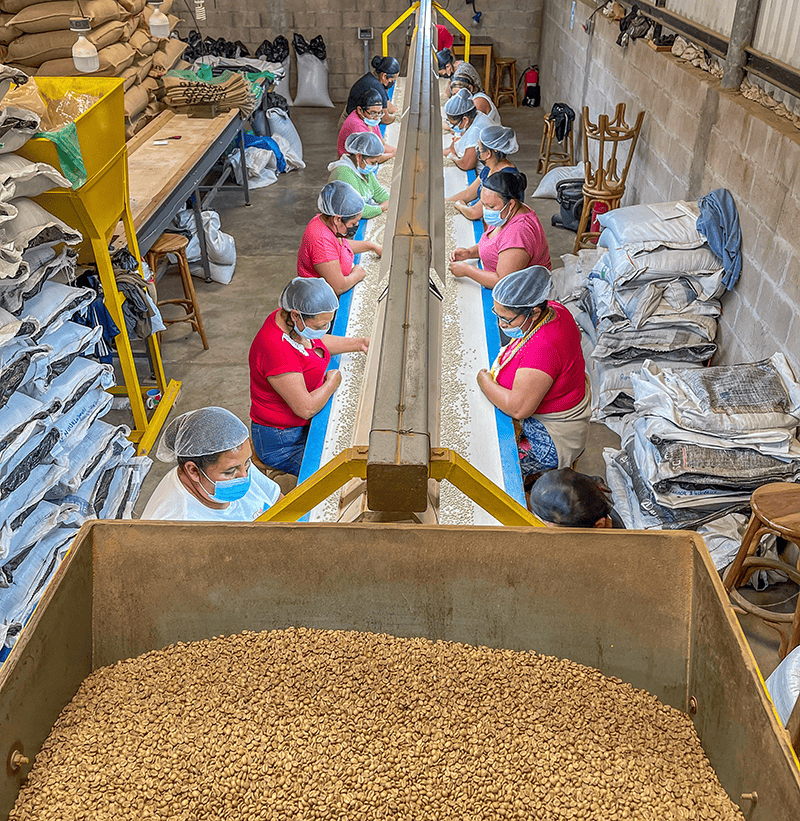
And those issues fell especially hard on women in the market, who already face inequalities in many of the largest coffee-growing countries, according to the Gender Inequality Index, a composite metric produced by the United Nations Development Programme. “Unfortunately, we see inequity in terms of access to land, finance, and knowledge, which translates into reduced crop yields, household income, and revenue from sales for the female-operated farms,” Bartley said.
Challenges remain in part because of cultural norms. “In some countries, it is still not customary for women to have the same land access rights or to inherit land in the same way as their male counterparts,” Bartley said. “In many coffee-producing countries, women still lag in having the same access to education and have lower rates of literacy.”
Access to financial resources is a major factor as well, as women in many coffee-growing countries tend to have more difficulty gaining formal credit due to having less collateral or none. And because of the double burden of attending to household/family work and having reduced mobility, women tend to not participate in cooperative organizations that would provide them the kinds of additional resources that many men have access to, Bartley said.
“Addressing these many issues is critical to downstream portions of the supply chain, and in fact some processors like Nespresso have launched official programs to improve these issues,” Bartley said. Nespresso is Nestlé’s international marketer of coffees, coffee machines, and accessories, and operates more than 800 cafes around the globe. Bartley said that in 2017, the company established a gender equality study called the Nespresso AAA Sustainable Quality Program. It uses a gender analysis tool “to better understand the issues women face in the farming community and developed and delivered trainings to reduce the inequity,” she said.
Equity issues
Shimon Gowda, a technical project manager contracted with Apple Inc., in Sacramento, California, has been a supply chain manager and consultant throughout her career. She noted that gender equity in the coffee industry in her home country of India cries out for change.
“Gender equity in the Indian coffee industry is imperative for both ethical and strategic reasons,” said Gowda, who comes from an agricultural family business and holds a master’s degree in industrial engineering from Rutgers University. “Historically, women have played a crucial role in coffee cultivation, yet they often receive disproportionately lower wages than men, reflecting deep-seated biases and limited opportunities.
“Addressing this disparity is not only a matter of social justice but a strategic investment in the industry’s future,” Gowda said. “By providing equal opportunities and fair compensation, we unlock the untapped potential of women, fostering a more diverse, innovative, and resilient coffee supply chain.” It’s not just about rectifying past injustices, she explained, but about looking forward and making a commitment to sustainability and the farmers’ long-term success.
“Additionally, supporting small-scale farming helps maintain biodiversity, as these farmers often employ environmentally friendly and traditional cultivation practices,” Gowda explained.
To determine if the coffee they are buying comes from such sources, consumers can look for certifications like Fairtrade, which prioritizes empowering marginalized groups, including women, and helps small farmers earn a living wage. (See “What Is Fair Trade?” sidebar)
“Direct trade models, where roasters establish direct relationships with farmers, also offer transparency, allowing consumers to trace the origin of their coffee,” Gowda said.
In India, some coffee cooperatives and initiatives specifically focus on empowering women in the coffee value chain, providing training, market access, and financial assistance. Consumers keen on supporting such initiatives can explore Indian coffee brands that promote gender equity and sustainable practices, ensuring that their coffee choices contribute positively to the well-being of women owners of small coffee farms in Indian, Gowda said.

“By providing equal opportunities and fair compensation, we unlock the untapped potential of women, fostering a more diverse, innovative, and resilient coffee supply chain.”
— Shimon Gowda
Next steps
After growing, the next step in coffee handling is called processing. Owners of small farms who do not have the means to process coffee beans themselves often partner with processors who manage the beans by hulling or milling them. Pods called cherries typically hold two of the green coffee beans apiece. Once hulled, the green coffee beans are then processed and either roasted in-house or exported to roasters, who roast and package the beans for eventual shipment to retailers and other consumers.
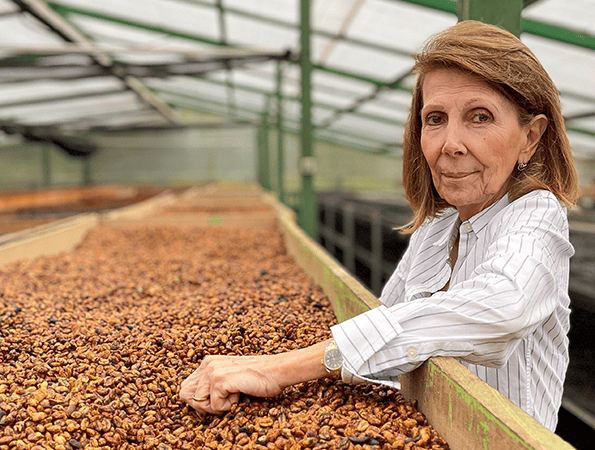
Carmen Elena de Silva knows all about bean processing. She entered the coffee business 36 years ago when she married Rafael Enrique Silva Hoff, a fifth-generation coffee producer. The couple now owns four small specialty coffee farms high in the Apaneca-Ilamatepec region —1,450 to 1,650 meters above sea level — in western El Salvador.
The couple co-founded a business, Sicafe, S.A. de C.V., to unite their farms and better manage them. Sicafe now engages in coffee production, milling, roasting, and exporting. They produce Bourbon and Pacamara coffee, as well as new varieties such as Batian, Java, Geisha, SL-28, and SL-34, which are grown under shade trees. They use organic fertilizer that helps preserve humidity in the plants during the dry season. Workers handpick the coffee at perfect ripeness, and sun-dry and rake the beans by hand.
“We use farming techniques inherited from our ancestors, which have proven over the years to work and to help mitigate climate change.”
— Carmen Elena de Silva
“We use farming techniques inherited from our ancestors, which have proven over the years to work and to help mitigate climate change,” de Silva said.
The beans are processed in a number of ways, she said. These include natural fermentation, aerobic fermentation, anaerobic fermentation, and carbonic maceration. Fermentation brings out the coffee’s flavor.
In aerobic fermentation, freshly picked coffee cherries or freshly de-pulped coffee beans are poured into a container — often an open-air tank — and microorganisms break down the pulp into cellular energy and metabolize the sugars. Coffee producers keep a close eye to ensure the 16- to 20-hour process goes smoothly.
In anaerobic fermentation, the coffee is pulped and processed in sealed tanks without oxygen.
With carbonic maceration, the beans are dried with the pulp on and placed in a stainless steel barrel, where they are allowed to sit in a carbon dioxide-rich environment, much like in winemaking. The process produces fruity flavors in the coffee.
Once they have been fermented, the beans are transported to raised beds, where, de Silva explained, “they are pampered until they reach optimum dryness.” The beans take about 20 to 45 days to dry, with those processed naturally requiring more labor and taking longer.
Sicafe has its own traceability program that lets it track coffees by lot, farm, variety, and process. In each processing stage, the people in charge of that stage feed into the system such information as the coffee’s yield, quality, state, and location, de Silva said.
Twenty years ago, de Silva and Hoff started exporting their processed beans to Europe and the United States, and 18 years ago they won their first Cup of Excellence — the most prestigious competition and auction for high-quality coffees — for the crops from two of their farms, La Fany and La Siberia.
Quality matters
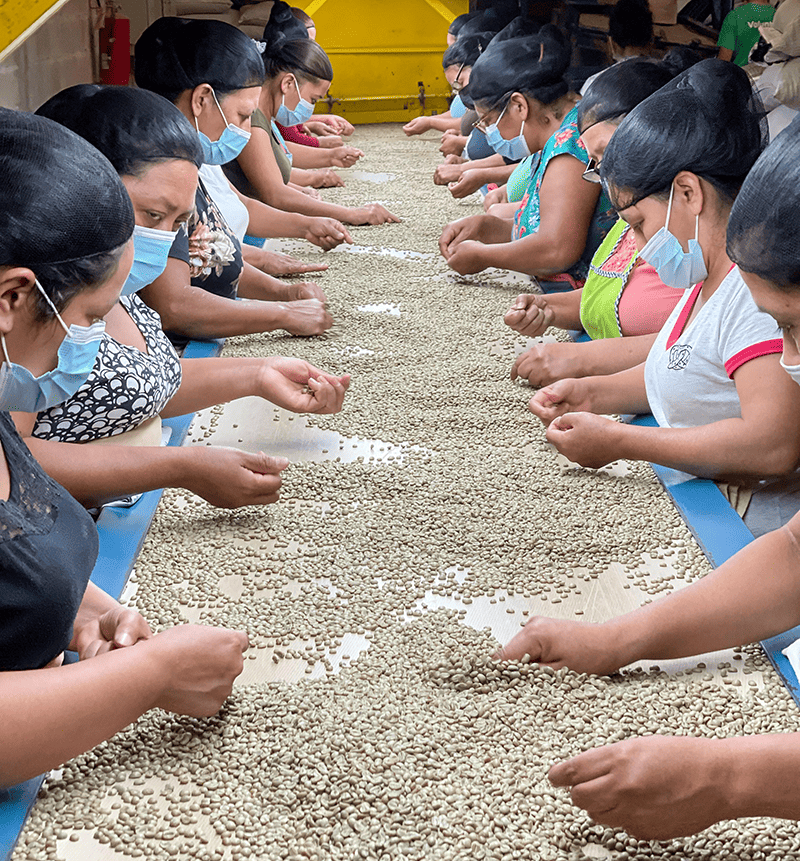
On the other side of the supply chain from exporters like de Silva and Hoff are importers, and many are becoming aware of the beans’ provenance and quality. At the Amsterdam headquarters of Trabocca, a specialty coffee company that imports high-quality, organic, and fair-trade coffee from Colombia and Honduras, women make up the entire quality assurance team.
Simone Blonk, a quality assurance engineer at Trabocca, maintains communication with suppliers and subcontractors for product approval and coordinates quality-related corrective actions. She also helps ensure compliance with European Union regulations aimed at addressing deforestation.
Blonk’s supervisor and global quality manager, Cerianne Bury, supervises a team that places a high priority on supporting initiatives and projects that benefit coffee growers and their communities. Programs have included the Suke Quto School Project, which improved schools for children in one of the largest coffee-producing regions in Ethiopia; the Cookstove Project, which is replacing wood-fired home cooking in Africa with lightweight cookstoves; and the Living Income Project, which is collecting data about how much money coffee farmers earn — an elusive number given the complicated commodity pricing system. (See “What Is Fair Trade?” sidebar)
What Is Fair Trade?
Fair trade is a practice that aims to treat developing nations’ workers and the environment fairly by paying producers an above-market, “fair trade” price for their goods, provided they meet specific labor, environmental, and production standards. Fairtrade International (Fairtrade.net) is a federation that represents small-scale farmers in producer networks from three global regions: Asia-Pacific; Africa and the Middle East; and Latin America and the Caribbean. According to the website, a product certified and labeled as “Fairtrade” has met internationally agreed-upon standards that have been independently certified.
Coffee prices are based on a commodities market that often experiences wild fluctuations — and significantly more lows than highs. As a result, coffee farmers must often sell at prices below their production costs. Fairtrade aims to give farmers stability in this unpredictable environment by offering what is called a fair trade minimum price (recently raised to $1.80 per pound) to serve as a financial safety net when market prices drop. Coffee farmers also receive a 20 cents per pound Fairtrade premium — an extra sum of money paid on top of the selling price — that farmers and workers are to invest in business or community projects of their choice. The premium, which varies, helps pay for community projects such as school renovations and health centers, and to buy machinery and equipment to improve farming operations, according to Fairtrade.net. Certified organic coffees receive an additional premium of 40 cents per pound.
Fair trade standards, which vary with the coffee growers’ size and business, ensure that the coffee is traceable by keeping it separate from noncertified products all the way from farm to shelf. The standards aim to ensure coffee farms provide safe working environments and fair wages, working hours, and benefits to prevent worker poverty and forced labor. The standards also aim to increase the number of women who own and run their own farms.
The Fairtrade network applies to a host of commodities, from coffee to cocoa, cotton, and flowers, but coffee is significant because it’s the eighth most-traded commodity worldwide, provides livelihoods for 125 million people, and is a significant part of the gross domestic product of 50 coffee-growing countries.
“Coffee farmers work too hard, and they take on so much risk and so much debt, all in the process of providing us with this beautiful beverage,” said Monika Firl, senior advisor on coffee for Fairtrade International. “Why wouldn’t we support them?” — SG
Blonk’s colleague and pioneering coffee trader, Maria Porto, brings a unique background to her role. Coming from Brazil, the world’s leading coffee-producing country, Porto’s early connection to the coffee industry was rooted in her grandfather’s coffee farm.
Her experience working for a coffee exporter, and now an importer, gives her key insight into how the coffee supply chain functions, from cultivation to international trade. Porto plays an active role in enhancing and streamlining the company’s online coffee purchasing portal, trabocca.com/mytrabocca/. The platform provides real-time tracking of when the roasters purchase the coffee and when specific coffees become available. Porto said she appreciates the ability the technology gives her to connect with existing and potential customers and find solutions to match roasters’ needs.
Porto is among only 10% of coffee traders who are women, according to an International Trade Centre report. “Indeed, at Trabocca, I am proud to be one of the first woman traders in the Amsterdam office, a role traditionally dominated by men,” she said.
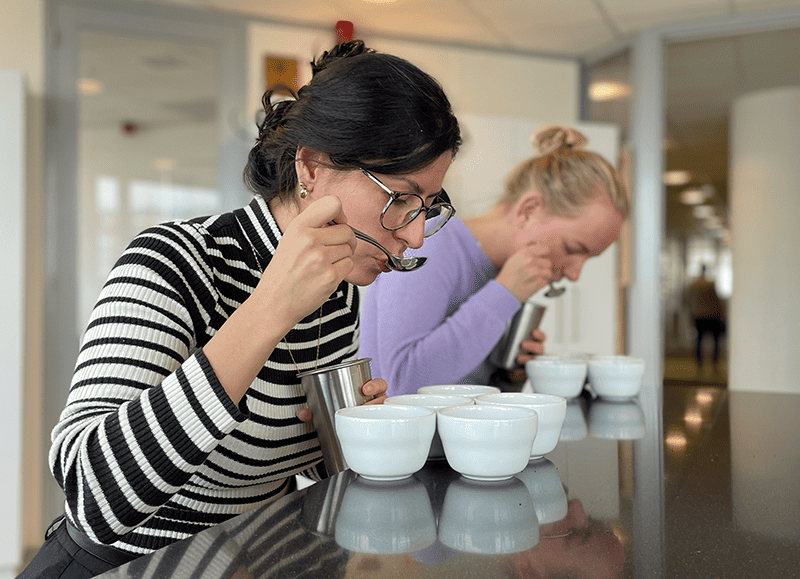
Porto’s role as a coffee trader at Trabocca allows her to connect roasters with coffees from the Café Femenino Program, an organization that seeks to properly compensate women coffee farmers around the globe. And she has engaged with the International Women’s Coffee Alliance and started a women-only coffee-tasting contest in Brazil. Blonk, a former barista, explained that the art of coffee tasting, known as “cupping,” enables a team to evaluate, grade, and calibrate various coffees. “When you taste specialty coffee, it is not as dark and bitter, but you taste the delicate, fruity acidity,” Blonk explained.

“We are working to provide customers the ability to make a difference, even if it is in small increments every day, because small change — in cents and shifts in actions — can make a big difference, collectively, in the end.”
— Kristi Ross
Transparent trade
Many coffee sellers, including independent cafe operators, also follow the supply chain and place value on supporting small farm operators, sustainable farms, or other typically marginalized players in the market. Kristi Ross, a serial entrepreneur and angel investor who has researched the coffee industry, said it is ripe for change.
“Once you start to unpack it, you see that there are still areas of inefficiencies and areas for innovation,” said Ross, who decided to co-create a coffee venture with husband Craig Ross, a healthcare industry executive and consultant.
The suburban Chicago couple aims to connect farmers, entrepreneurs, and coffee drinkers through their startup, U3 Coffee, launched Nov. 1, 2023. They started the company and its companion website (u3coffee.com) — complete with online stories, blogs, and podcasts — so customers could learn everything from how to brew like a connoisseur to how coffee begins, with farmers picking cherries from bushes.
Ross said that, for farmers, sustainability is “still a significant issue.” To her, sustainability means paying fair wages and motivating the next generation to continue the trade. “On top of that, climate change will affect these regions — potentially catastrophically,” Ross said.
The company’s business model includes what it calls the U3 Coffee Bank, a charitable arm that supports sustainable farms and roasters of all sizes. “We aim to highlight the farmers’ stories, educate, and help bring resources to coffee regions dictated by their indicated needs,” she said. “U3 Coffee Bank seeks to discover farms that do not yet have sustainable farming practices and help them obtain and build that.”
By partnering with roasters, cafe owners, and other entrepreneurs, U3 Coffee hopes to help share business knowledge that many “amazing coffee artisans” may not have, she said.
“For the end coffee consumer, we aim to engage and elevate their coffee experience and knowledge through information and education,” Ross said.
The company also operates the U3 Coffee Exchange, an online marketplace featuring its “flagship bean,” the Tarrazu Estate from Costa Rica (described as having “notes of milk chocolate and caramelized sugar with a hint of orange”) and will open a brick-and-mortar cafe in Forest Park, Illinois, a suburb west of Chicago, this spring — complete with its own roastery and rooftop deck for events.

“Climate change will dramatically affect coffee yields. We need to reduce water use and employ more recycling.”
— Jackie Process
Tip forward
Ross wants her retail coffee customers to be able to tip coffee farmers just like they tip a barista.
“We want to meet the customer where they are and show how they can make a difference at the most opportune time,” Ross said. Most customers don’t realize the effort by small and sustainable farms that can go into a cup of coffee, she said, and being able to tip the farmers directly “provides them an opportunity to take action with their daily cup of coffee.”
Ross said she plans to use blockchain technology to enable this tipping. Blockchain can provide transparency to the prices paid to farmers — and every step along the supply chain, she said. “We are working to provide customers the ability to make a difference, even if it is in small increments every day, because small change — in cents and shifts in actions — can make a big difference, collectively, in the end.”
Technology also holds the promise of improving the entire supply chain. The Internet of Things and other digital tools will reduce reliance on brokers, better monitor bean quality, and more quickly move capacity around through analytics and automation, according to Bartley.
“Within warehousing specifically, sensors and drones can better locate inventory, and environmental monitoring for moisture or temperature can allow companies to improve shelf life,” she said.
“Technologies we are hearing about across the supply chain to increase visibility and transparency up the value chain are also being used or considered in the coffee markets,” Bartley said. “For example, using blockchain technology can allow companies to verify the quality of specific grades of coffee, or better trace where the beans were produced.”
The actual distribution process itself relies on the same technology advancements that can be seen in almost any logistics space. “Specific to coffee bean technology innovation, we’re seeing a push toward better monitoring soil and nutrient levels,” Bartley said. “We’re seeing drones being used to provide data in mountainous and remote regions and digital tools to predict coffee quality. Access to these tools will also further support female-led farms in improving crops.”
Gowda said the coffee industry has already seen the beginnings of a technology revolution that has fostered transparency, sustainability, and circular economy practices. “Geographic information system mapping and satellite imagery offer precise insights into coffee farms, promoting sustainable agriculture,” she said. “Innovations like coffee cherry husk recycling contribute to a circular economy, minimizing waste. These technological advancements collectively drive positive environmental and social impacts, reshaping the coffee industry toward a more transparent and sustainable future.”
A Question of Quality
Melissa Villanueva, whose family hails from the Philippines, started the Brewpoint Coffee cafe outside of Chicago with the motto, “We seek to build a more equitable and inclusive world through coffee.”
Villanueva — co-author of the book Starting and Running a Coffee Shop (Penguin Random House, 2019) and a mayoral appointee on the Economic Development Commission in Elmhurst, Illinois, a western suburb of Chicago — said she sees Brewpoint Coffee’s mission as a way to live out her values.
“We want to build as fair a system — throughout the entire coffee system — as we can,” she said. “We want to be able to pay wages that make the coffee trade viable for farmers and for our team.”
Brewpoint pays its staff a starting wage of $10.50 an hour plus tips, which come in at $5 to $8 an hour, depending on the location; Brewpoint has four shops in Chicago’s suburbs.
The company pays its coffee farmer/suppliers, on average, $2 per pound or more above Fairtrade standards (See What is Fair Trade? above.) and is one of the top two buyers from the Farmers Project, a woman-owned program that helps local farmers in Costa Rica sell their coffee for a fair price, share best practices, and export their specialty coffee together.
Brewpoint prides itself on buying primarily via direct trade, Villanueva said. That eliminates middlemen and provides farmers upfront payments rather than monthly payments. “When we buy a full crop for a year, that’s a payment of $120,000 upfront versus $10,000 per month,” she said. “When farmers sell their crop, they sell it in one batch. They want to secure payment all at once. It wouldn’t make sense for us to pay once a month.”
Climate change is making the mission more difficult, Villanueva said, because coffee plants must be picked at exactly the right time to ensure optimal specialty and quality — and the right time keeps changing. That can hurt the grower’s profits because they cannot produce the crop they had anticipated. “The harvest is coming in much earlier or much later than in the past,” she said. “Global warming is a never-ending issue.”
Another hurdle is customers’ price expectations, Villanueva said. Unlike with wine, coffee customers aren’t accustomed to paying more for higher quality. “People who are accustomed to paying $1 a pound for Folgers are not willing to pay that much more to get an amazing cup of coffee,” she said.
Haley Sliwa, Brewpoint’s head roaster, said the company is intentional about working directly with farmers and choosing to buy from underrepresented groups. “It’s all about connection with people from around the world,” Sliwa said. “I choose intentionally the coffees I’m excited about because I understand the chain of where it came .”
Among the factors affecting quality are weather, altitude, soil conditions, and a system of adding fruit to the coffee while it’s fermenting, Sliwa said. After Brewpoint Coffee receives its coffee beans, it roasts them to its specifications and packages the end product with its own label. Its business strategy also includes hosting events, including those for entrepreneurs, small business pop-ups, and social justice organizations such as LGBTQIA+ groups. — SG
Cold brew
Innovation is also brewing in the types of coffee products that reach consumers. A senior systems engineer with a Boston-area startup called ColdSnap has the enviable job of helping design and launch a technology that will produce single-serve “Snappuccinos” (frozen lattes), smoothies, margaritas, protein shakes, and premium ice cream.
“In New England, we love our iced coffee — and the trend toward cold coffees is escalating,” said Jackie Process, who majored in nuclear engineering at Penn State and is developing a systems-focused environment to ensure ColdSnap’s machine meets quality and functionality requirements.
The machine is unique because it requires no water line and no cleaning. Pods the size of a Red Bull canister go into the machine. The pods, which can be stored at room temperature, come in mocha and French vanilla flavors. When you put a pod for coffee, ice cream, or a mixed drink into the machine, the machine rapidly freezes, mixes, and dispenses the pod’s contents in two minutes. And the pods are made of recyclable aluminum.
“Climate change will dramatically affect coffee yields,” said Process, who previously worked at Keurig, the coffee pod and machine maker. “We need to reduce water use and employ more recycling, so the recyclable pods speak to that issue.”
The machines are being beta-tested in offices, arenas, stadiums, convention centers, and other commercial sites. They’re scheduled to launch in early 2024.
As an engineer, Process has appreciated being able to work in teams with diverse professionals, such as those in design, marketing, legal, and sales fields. And she also aims to do a bit of her own disruption.
In her first job out of school at another company, Process was the only woman engineer in the workplace, and her managers put her desk next to the company’s administrative assistant. “Those first couple years out of school, I struggled to find my voice,” she said. “I had a lot of micromanagement. I don’t want anyone else coming into a workplace who reports to me to feel that way. I want to make sure — my goal as a manager — is to fill that mentor role, to be a manager who helps people figure out what they want to do, to grow in their career, and to realize their goals.”
Resources
“Historic coffee prices percolated after a bitter global supply crisis,” bls.gov
“The Coffee Value Chain,” Fantine.io
“Gender Equality in the Coffee Sector,” International Coffee Organization
“Gender Equality: Planting the Seeds of Prosperity,” Nespresso
“Women in The Coffee Industry: What You Should Know,” PerfectDailyGrind.com