


Are you encouraging students and professionals in your network to vote? If you are a college student, are you registered to vote?
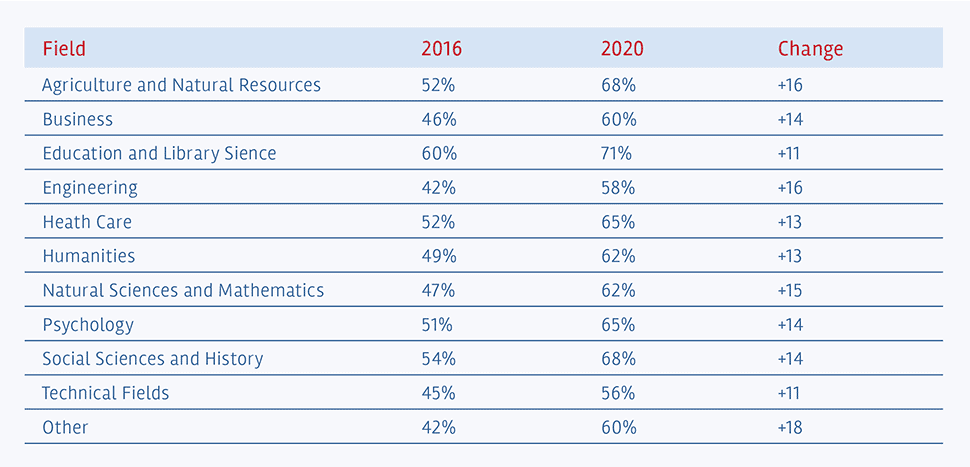
Those majoring in engineering and technical fields have some of the lowest voting rates among college students. But that can change.
The Institute for Democracy and Higher Education at Tufts University has been tracking student voter turnout, using data from the National Study of Learning, Voting, and Engagement. This database of more than 10 million de-identified student records includes students from two- and four-year public and private colleges and universities from across the United States.
Researchers were pleased to see that student voter turnout had risen, from 52% in 2016 to 66% in 2020.1 But while the voter turnout among students in engineering and technical fields was higher in 2020, the voting rates were the lowest (see Figure 1).
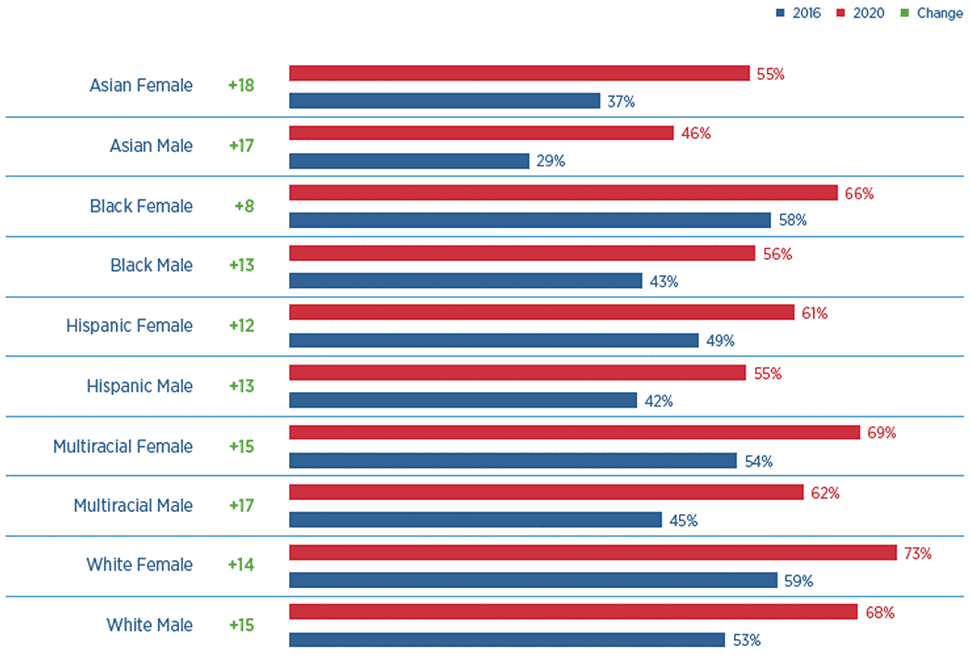
Though college women have higher voting rates than men, women in science, technology, engineering, and mathematics still vote at lower rates than women with other majors.² In the 2016 and 2020 elections, Asian women voted at lower rates than women of other races (see Figure 2). White women voted at the highest rate.
If you have not registered to vote or know someone who hasn’t, find out how at vote.gov. Don’t wait; some states require voters to register up to a month in advance of an election.
Not sure if you’re registered? You can check your voter registration and find out what’s on your ballot at vote411.org.
Figure 1: Voting Rates by Field of Study, 2016 and 2020
Representation required
In addition to increasing STEM representation among voters, we also need more people in government leadership with STEM backgrounds. Those with STEM experience are best equipped to understand the need for additional support for diverse STEM talent. Unfortunately, STEM professionals are poorly represented in the U.S. Congress. Profiles of members of the 118th U.S. Congress show that the most common professions are law, business, and public service or politics. At full capacity, the House of Representatives has 435 members, but currently just eight are engineers, two are physicists, and two are chemists. Out of 100 Senators, only one is an engineer and one is a geologist.³
Figure 2: Voting Rates by Gender and Race/Ethnicity, 2016 and 2020
It’s regretable that we have so few in Congress with STEM backgrounds because STEM professionals make great public servants. UNESCO notes that engineers are ideally suited to public policy. They are trained to analyze problems, and they focus on finding solutions rather than winning arguments.⁴ As SWE continues to advocate for policy changes to support women in engineering and technology, government leaders with STEM backgrounds have often been SWE’s strongest supporters.
If you are interested in learning more about how public policy works, engage with SWE’s public policy initiatives at swe.org/public-policy/. They may just inspire you to run for office!
Get Ready to Vote
Here are the steps to prepare to vote and cast your ballot as listed at Vote411.org, a nonpartisan nonprofit funded by the League of Women Voters Education Fund. All steps can be taken directly from the Vote411.org site:
- Check your registration and/or register to vote
Check Vote411.org’s online tool to see if you are registered in your state. If not, take two minutes to register. - Learn about your early voting options
Many states offer absentee, mail-in voting or early, in-person voting. - Explore your day-of voting options
Find out where you can vote in person, what voting machines are used, and what you need to bring with you on Election Day, Nov. 5. - Research candidates
Learn where candidates in your area stand on the issues and what measures are on your local ballot. - Share your plans
Tell your friends and family what you learned by making your voting plan and encourage them to make their own.
Footnotes
- Thomas, N., Gismondi, A., Gautam, P., and Brinker, D. (2021). “Democracy Counts 2020: Record-Breaking Turnout and Student Resiliency.” Institute for Democracy and Higher Education at the Jonathan M. Tisch College of Civic Life, Tufts University.
- Bergom, I. and Ro, H.K. (Jan. 29, 2018). “Why don’t STEM majors vote as much as others?” The Conversation.
- Manning, J. (2024). “Membership of the 118th Congress: A Profile.” Congressional Research Service.
- Galloway, P.D. (2010). Engineers in government and public policy. Engineering: Issues, Challenges and Opportunities for Development (pages 175-178). UNESCO.