
Q The theme for your presidency is “Embrace Your Story.” Why did you choose this phrase, and what does it mean to you — personally and professionally?
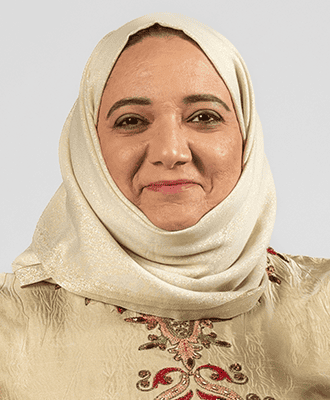
A “Embrace Your Story” involves two things. I want us all to embrace our uniqueness as individuals but also recognize that our stories also involve other people. This applies to me from a personal, professional, and SWE perspective.
I was born in Germany to Libyan parents. My father was a co-founder of an organization that was against [then Libyan dictator Moammar] Gadhafi, so we ended up traveling the world to spread the word about how evil he was and to escape persecution. From that perspective, my story is about perseverance.
Professionally, it’s about embracing successes as well as failures because not all failures are bad. Not every win is as important as some failures that turn into career pivots, for example.
It’s also about the fact that each one of us is unique, and we don’t all have to follow the same career trajectory or personal life trajectory.
Q What are some key moments in your journey with SWE that stand out and perhaps helped to define your theme?
A When I was an undergrad at the University of Kentucky, I served as president of my section. Then I moved to attend graduate school at The University of Texas at Austin. I went to the professional meeting and the collegiate meeting and just didn’t feel like I fit in at the time. While I maintained my SWE membership, I thought maybe it was time for me to do something else. I completed my master’s degree and then started working for the engineering firm Trinity Consultants, in Columbus, Ohio. I wanted to meet people, so I went back to SWE. It was such a welcome home. I recognized many of the professional members and leaders at some of the events I attended in the region.
Then when I moved from Columbus to Houston, I realized that my SWE career journey needed to pivot again. I started to wonder what else I could do at the Society level. I served as a Society-level scholarship coordinator and then went on to lead the curriculum committee. Then I found myself on the nominating committee. All of those were pivots, and they helped me speed up my leadership journey.
Q SWE has made tremendous progress in the past few years, with membership reaching 50,000 and the annual conference in Chicago breaking attendance records for the second year. How do you plan to lead SWE toward capitalizing on these successes?
A I want to build up our community. I want us to continue to inspire, embrace, and empower women at all career stages, of all backgrounds, to fulfill their best potential.
Q Many circumstances have changed within the past few months, with strong pushback in the U.S. especially to programs centered on creating equity and fairness. What do you believe are SWE’s greatest challenge and most significant opportunity for fiscal year 2026?
A Representation is really one of our biggest challenges because women engineers as a percentage of the total are still in the low teens. By saying that we’re being equitable we’re acknowledging that different people have different needs. Without team members from diverse backgrounds, we would not have the solutions we have today in engineering. There’s a reason why engineers work in teams. We need to demonstrate that our diversity is what empowers us and what supports great innovation.
Q SWE has expanded its reach globally with affinity groups, targeted content, and WE Local events that attract thousands of women in key cities in the U.S., Europe, India, and now Brazil. What might SWE do differently in the coming years to ensure it is meeting the needs of all its members?
A We are setting up our volunteer opportunities so that we have a wider variety of options. Historically, volunteer opportunities on the Society level have involved a commitment of multiple years. But many people may not have the opportunity to serve that long. We are making sure that we have volunteer opportunities for shorter periods, sometimes for just a couple of months. Others might be for a couple of weeks, related to judging or reviewing, for example. And we want to make sure that we provide a list of those volunteer roles so members — no matter where they are in their careers or where they are in the world — understand what those opportunities are.
We’ve also added the directorate level of volunteer responsibilities between our working group leadership and our board of directors. The directorates will focus on society strategy, community building, content strategy, recognition and resources, pathways, and nominations. Pathways promotes the growth and development of our members from the precollege years through all stages of their careers.
Q One-quarter of all engineering students in the U.S. in 2021 were women, yet the percentage of practicing engineers who are women hovers around 15%. What can SWE do to boost these numbers and help more engineering students remain in the profession?
A The most important things we can do are provide technical expertise and skill building, community building, and support networks. By lifting up other women and offering encouragement and support, we can increase that number and make sure women understand they belong in engineering.
Q When did your interest in engineering as a field of study arise, and in what ways did your engineering education shape your decisions regarding your career?
A My dad is an electrical engineer. And I liked math, chemistry, and physics, so I thought: ‘Oh, I’ll just be an engineer.’ But I wanted to do something from more of an environmental perspective, and chemical engineering really stood out to me. When I was an undergrad, I did research on separation processes that could be done in an environmentally friendly manner.
Then when I got to grad school, I started to consider other things within chemical engineering. I hold a B.S. and an M.S. in chemical engineering.
Today I travel the world to help facilities comply with regulations and requirements so they can make the things that we need as a society but do it in an environmentally safe manner.
Q No one’s career is perfectly smooth. What was one career challenge you had to overcome that taught you a lasting and meaningful lesson?
A When I got to grad school, I thought I would go on to get my Ph.D. I loved doing research and I thought that was what my career was going to be.
But in the middle of graduate school, I experienced a medical issue, and couldn’t finish grad school at that time. I felt like a failure because I didn’t accomplish my goals, but I learned how to pivot. I got my master’s degree in the end, and I got a different job, and that’s how I ended up at Trinity, where I have worked 21 years.
And I really love what I do. I work with great people. I still get to do research — not necessarily in the same way, but I get to work with facilities and help them come up with novel solutions.
Q How would you describe your leadership style?
A I will ask for input and I like to do consensus building. But once I have enough information and the decision’s made, I am ready to move on. My main concern is that we accomplish our goals.
Q Now for a couple of fun questions: What’s your favorite SWE swag and why?
A My SWE toiletry bag, and my life member and anniversary pins because they give me a sense of accomplishment.
Q Do you have a personal motto? If so, what is it?
A Everything happens for a reason. And that’s truly what “Embrace Your Story” means.