

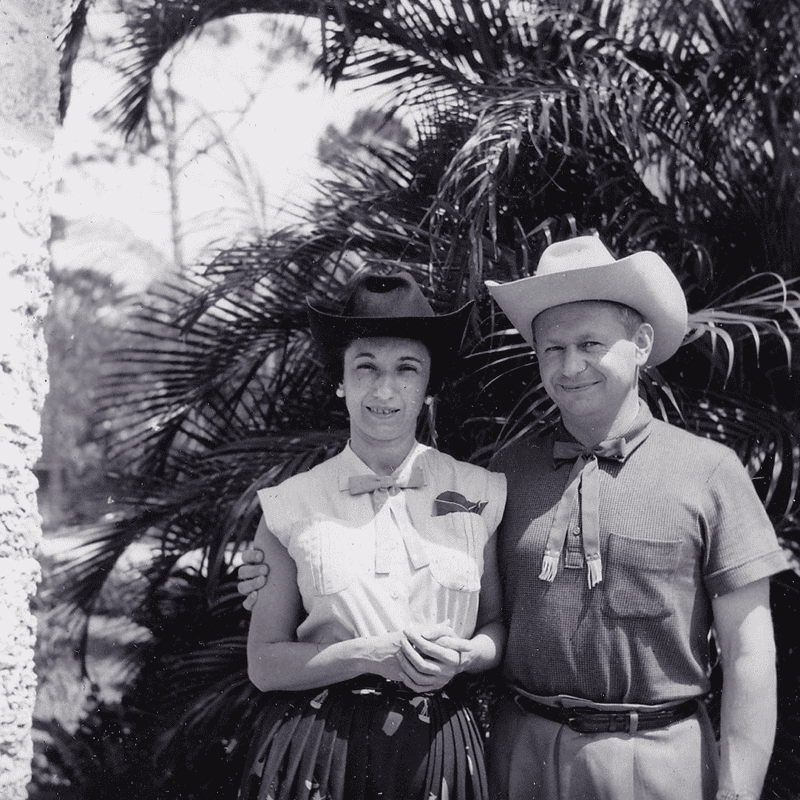
Miriam “Mickey” Gerla unexpectedly became the president of the Society of Women Engineers in November 1956 just two weeks after unexpectedly becoming its vice president. She inherited a 6-year-old organization with insufficient funding, an unwieldy 29-person board of directors, overwhelmed volunteers scattered across the country, and inefficient and poorly documented procedures and operations.
With no office space or paid staff, and with long-distance phone calls being prohibitively expensive, SWE leaders and volunteers conducted nearly all of SWE’s business via mail, at the speed and favor of the U.S. Postal Service. Gerla’s letters to compassionate confidants over the following two years poignantly express the challenges and burnout she faced while struggling to lead the Society toward a more stable future.
Gerla, of Forest Hills, New York, was a director-at-large on SWE’s board in July 1956 when Dorothea “Dotti” Perry, the Society’s vice president, unexpectedly died. A founding member of SWE and former chairman of the New York Section, Gerla was formally appointed to fill the vacancy at the end of October. (Section presidents were referred to as “chairmen” until the late 1970s.) Shortly thereafter, SWE President Lois Graham McDowell resigned, explaining in a Nov. 12, 1956, letter to the board that in addition to her disagreement with them on a key issue, the 71 hours she spent each week teaching and working on her dissertation research left far too few hours to adequately fulfill the president’s duties.
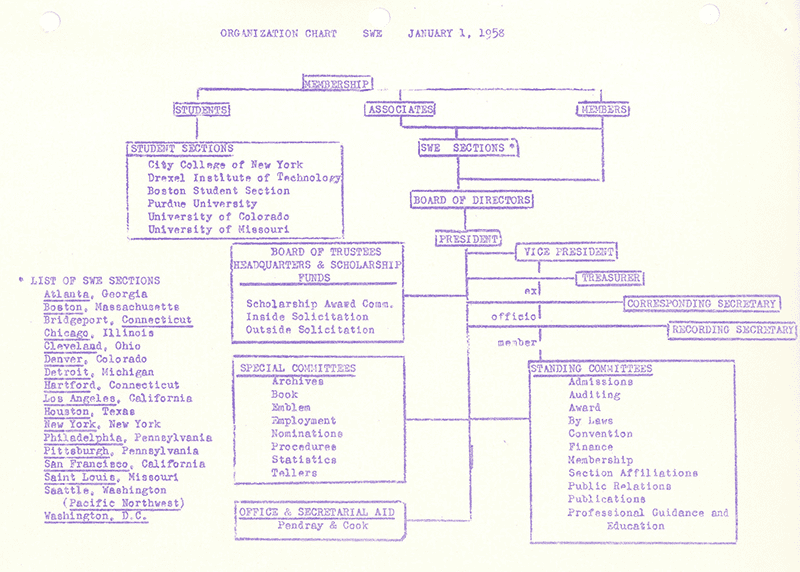
As the new president, Gerla wanted to lead the revision of the Society’s bylaws, policies, and procedures with an eye toward improving operations and efficiency. The volume of mail she received made progress difficult.
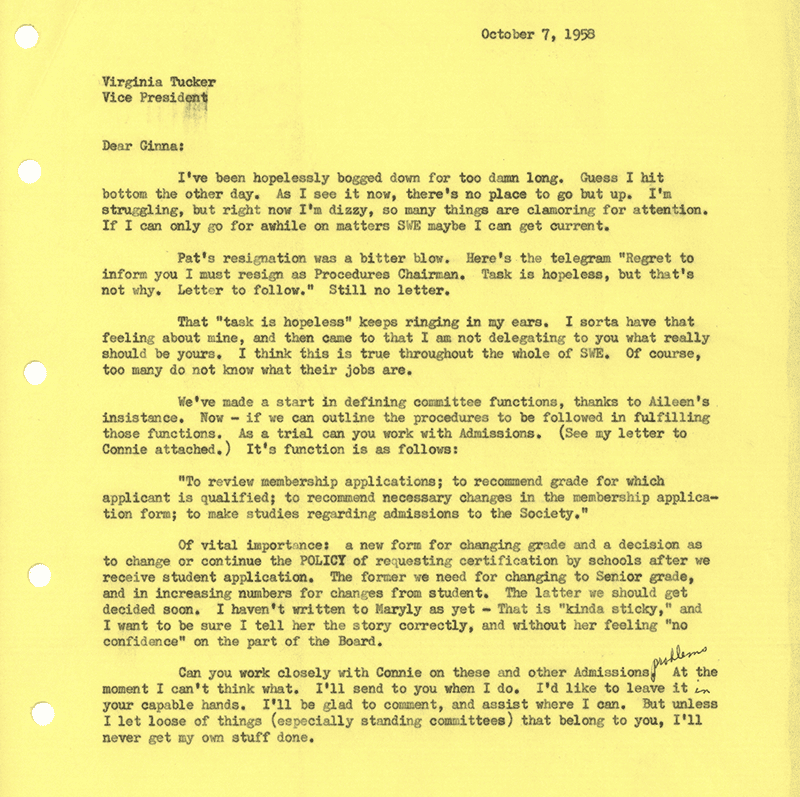
“Please forgive the delay in answering your last letter,” Gerla wrote seven days after Graham McDowell’s resignation in a Nov. 19, 1956, letter to Society treasurer Catherine Eiden of Oak Park, Illinois, “but so many things were marked ‘rush’ these last few days that I had to take the ‘extra special rush’ ones first. I still am on the ‘special rush,’ and will get to the ‘rush’ ones soon.” The time commitment and responsibility of shepherding SWE to success weighed heavily on Gerla, who confessed to Eiden in a May 1 letter that, “While I am in the mood this morning to have a good cry on your shoulder about the lack of funds, the lack of understanding of the problem, and about a hundred other things, I have too much work ahead of me to indulge.”
While she tried to approach the Society’s challenges with optimism, Gerla’s letters in spring 1957 often speak of fatigue, stress, and discouragement as she spent upward of 35 hours each week on SWE affairs in addition to her work in management consulting.
“I fell into the deep hole for about a week or so,” she admitted to Eiden in a May 25 letter, following a disagreement with the board of trustees on the feasibility of hiring secretarial help. “But when I climbed out, I was better equipped to handle the next big trap when it comes along — and come along it will, whether in SWE or elsewhere.”
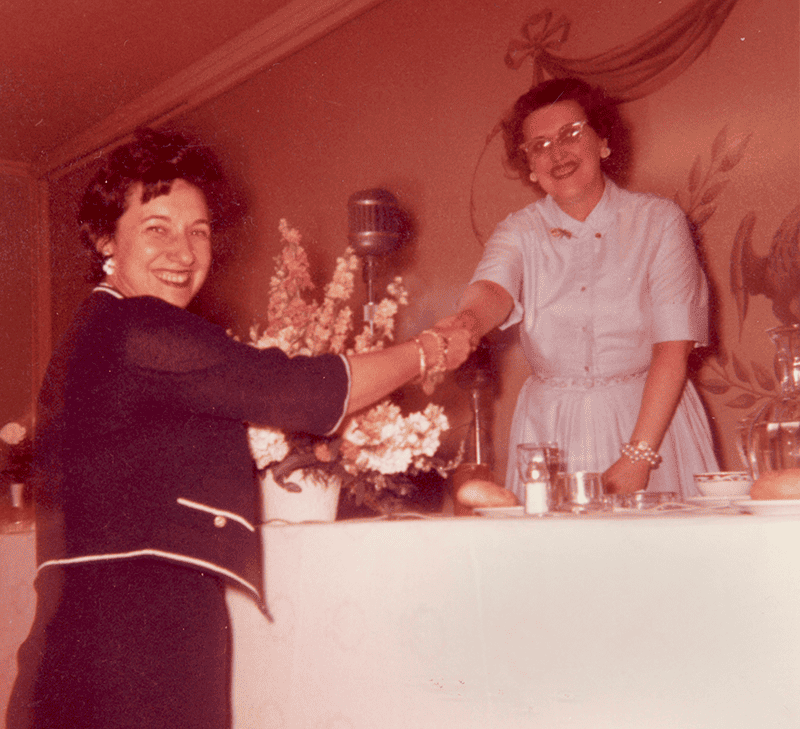
Despite the challenges, Gerla served a second term as president in a year punctuated by anemia (the partial source of her fatigue), caring for an ailing uncle, and glaucoma exacerbated by the extensive reading and typing she did as SWE’s president.
“It certainly was a help to know I had so many friends sending me good wishes when I wasn’t well,” she told recording secretary Virginia Tucker of Santa Monica, California, in an Oct. 30, 1957, letter. “They all helped.”
By the end of her tenure as president in June 1958 the Society was on better footing, with about 650 members, a part-time secretarial service to lighten volunteers’ burdens, and a major bylaws revision that significantly restructured the Society and its operations.
“Yours is the first letter I’ve written officially since I’ve been out of office, and it’s simply wonderful to address you as ‘President,’” she wrote to newly elected president Eiden on July 10, 1958. “I know the troubles the job entails, but the pleasures are there, too. May the former decrease and the latter increase as the years go on.”