

The political and legal targeting of diversity, equity, and inclusion policies in the United States continues roiling the waters for corporations, large and small. Despite research demonstrating that a diverse workforce improves problem-solving, employee satisfaction and retention, and especially a company’s bottom line, voices resentful of these programs and all that DEI represents have only grown louder.
Reacting to a barrage of federal executive orders and legal actions, many American companies have disbanded their DEI offices, scrubbed the term from annual reports and websites, and eliminated employee resource and affinity groups. Some are changing the terminology to avoid the acronym, while still others hope to escape scrutiny by avoiding public statements.
The Business Case for Diversity on Executive Teams and Financial Outperformance
Difference in likelihood of outperformance of 1st vs 4th quartile¹
To determine which way companies are likely to go with their DEI policies, two professors and a postdoctoral researcher at the University of Massachusetts Amherst analyzed racial justice statements from 500 of the largest companies in the U.S. and published their findings in March on the website, TheConversation.com. The article, “We analyzed racial justice statements from the 500 largest U.S. companies and found that DEI officials really did have an influence,” states in part:
“When firms make stronger investments in DEI work, and their DEI professionals are more central to the national DEI network, those DEI professionals were more influential in producing stronger racial justice commitments. This reflects long-term firm investments and the development of a robust, influential DEI staff. As of March 2025, only 31 of the Fortune 500 signaled that they planned to roll back their DEI efforts or eliminate them altogether. Eleven firms publicly defended their DEI efforts, nine of which were among the strong racial justice responders in 2020. None of the firms that were silent in 2020 have defended DEI so far this year. So far among the Fortune 500, 92% of firms have remained largely silent about their DEI intentions. However, other firms have resisted these trends. The future of equal opportunity in U.S. employment will likely depend, at least in part, on how these silences and defenses are worked out in firms’ internal human resource practices and public commitments.”
A few companies are publicly supporting and even expanding their DEI programs, stoked by shareholder pressure. For example, Goldman Sachs shareholders overwhelmingly rejected two anti-DEI proposals directing the company to consider eliminating its diversity, equity, and inclusion-based compensation incentives for executives and to review legal and reputational risks stemming from the firm’s DEI policies, with each proposal receiving only 2% shareholder support at a recent annual meeting. (It’s noteworthy that shortly afterward, Goldman Sachs also dropped its DEI requirements for companies it takes public.)
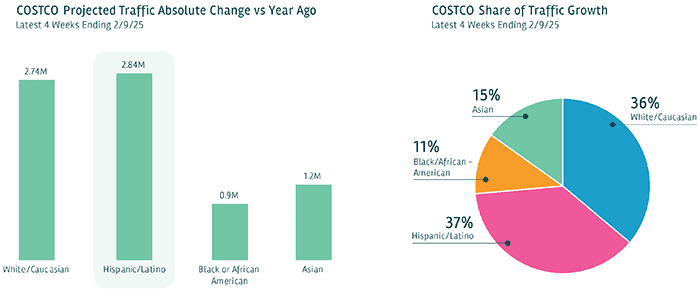
In the retail sector, consumer pressure to maintain DEI programs is also in play. Adrienne Pulido, vice president of DEI insights at the marketing data analytics firm Kantar, says that early data suggest Target’s rollback of DEI initiatives and its commitment to sell products made by Black-owned businesses “may be driving Hispanic and Black shoppers away, leading to declining traffic and market share.” The call for a national boycott of Target in April by Rev. Jamal Bryant in Atlanta also had a significant impact on the decline, according to articles in Fortune and Fox 5 Atlanta. “Meanwhile, Costco Wholesale, [which] is maintaining its DEI stance, has attracted these consumers, with Hispanic households fueling growth at nearly twice their demographic share,” Pulido says.
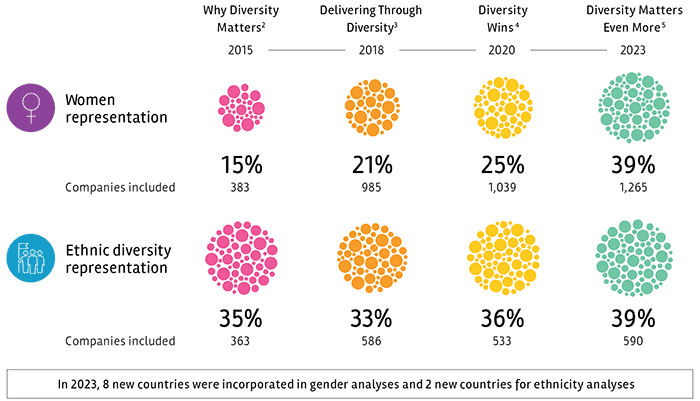
Since 2015, McKinsey & Company has delivered regular reports on the success of DEI and the business case for continuing these programs. Its fourth report, “Diversity Matters Even More,” was published in December 2023 and shows steady gains for women and ethnic diversity, even as anti-DEI attacks escalated.
Hispanic & Black households are contributing more than fair share to Target’s traffic decline
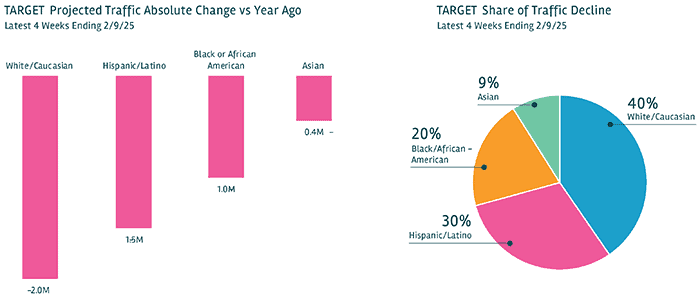
Hispanic households fuel Costco’s growth at nearly twice their demographic share
Room for improvement
If DEI is in crisis, is there an opportunity for reframing and strengthening it? The timing, development of, and ways in which programs were implemented by corporations, institutions, and governments may have complicated their path to success. In a May 2025 editorial for Inside Higher Ed, Michael Yassa, Ph.D., the former associate dean of DEI at the University of California, Irvine, writes: “Too often, DEI structures are set up with grand titles but little actual authority. They’re underfunded, overburdened, and expected to carry the weight of transformation without the tools to do it. Worse, they’re sometimes used for symbolic signaling while real decisions happen elsewhere. I still believe in DEI. Yet, I’ve seen how often it fails — not because the ideas are wrong, but because the execution is.
“Diversity, equity, and inclusion, when thoughtfully and strategically embedded, can be transformative. But when they become symbolic gestures, checkbox exercises, or top-down mandates imposed without trust or buy-in, they often backfire.”
Also in May 2025, EthicalSystems.org, a business ethics resource operated by the Institute for Corporate Governance and Ethics at Indiana University Kelley School of Business, published the blog post, Rethinking DEI in an Era of Outrage, by Alison Taylor, a clinical associate professor at the New York University Leonard N. Stern School of Business, and MBA student Bell Wilkins. They write, “It’s clear to both of us that DEI can and must do better, something well within the realm of possibility, given the prospective advantages to both employers and early-career talent. Corporations want hard workers who will add value and bring fresh perspective to the table. The young people in MBA classrooms want to work for leaders who consider a broader range of perspectives, appreciate the views of their customer bases, and reflect the demographics of today’s workforce.
“What would this actually take to achieve?” they ask. “This is a question DEI critics never fully engage with. It’s telling that the debate has been reframed as a problem of unfair boosts for minorities rather than an overdue correction to the dominance of a single identity group whose average member did not obtain positions through merit alone.”
By Any Other Name, It’s Still DEI
Between late February and mid-March, law firm Littler Mendelson, P.C. polled nearly 350 in-house lawyers, business executives, and human resources professionals across a variety of industries and organizational sizes. According to their report, published in May, “45% of respondents said their organizations would not consider new or further rollbacks of DEI programs, while an additional 32% said they would carry out such changes only to a small extent.”
Some of those small changes may be to the terminology used around DEI programs, stepping away from the flashpoint acronym while maintaining the spirit of their original policies. As Jeanine Conley Daves, J.D., an employment attorney with Littler Mendelson and a member of the firm’s IE&D consulting practice, told Fortune magazine, “It makes sense not to make extensive changes to efforts and initiatives that have helped to build a strong company culture.”
Some of the terms being adopted by U.S. companies to replace DEI include:
- Culture and Belonging
- Community and Engagement
- Equity and Impact
- Opportunity and Access
- Talent Strategy
- Inclusive Culture
- Belonging, Respect, and Fairness
- Inclusion and Belonging
- Justice, Equity, Diversity, and Inclusion, or JEDI
Job titles are changing, too. A DEI officer, for example, may become vice president of people or chief culture officer. Katie Oertli Mooney, managing director of workforce consultancy Seramount, advises on the company’s website: “Obsessing over the label (DEI or any other) at times distracts from our true goal: increasing understanding, support, and equitable outcomes in the workplace. If ‘DEI’ becomes a barrier to genuine conversation and action, explore alternative language that resonates better with your organizational culture.”
Resource: “DEI, Immigration Regulations Lead List of Employers’ Concerns,” Littler, May 2025.
“Now More Than Ever”
Since its founding in 1950, the Society of Women Engineers has been a nonpartisan organization with DEI as a cornerstone of its mission, crucial to achieving equal opportunities and equitable outcomes for all. In February 2025, the Society released a statement, “SWE Call to Action Amid Administrative Executive Orders,” quoted here in part:
“Recent executive directives in the United States present new challenges to fostering inclusive and equitable environments for women and underrepresented groups in engineering and technology. The Society of Women Engineers (SWE) is actively monitoring these changes to assess their impact on our members, partners, and programs. Now more than ever, we reaffirm our unwavering commitment to empowering women to reach their full potential as engineers and leaders. We stand resolute in our mission to advocate for gender parity, equity, and opportunity in STEM — regardless of shifting policies.
“This evolving landscape demands vigilance, collaboration, and resilience. SWE continues to engage with members, partners, our Board of Directors, and industry leaders to evaluate the broader implications of legislative changes, including executive orders that affect government-funded initiatives and policy, such as ADVANCE and Title IX, along with pressure on educational institutions to remove support of SWE sections. We recognize that these shifts may create uncertainty, but we encourage our members, allies, and stakeholders to persist in fostering inclusive workplaces, communities, and educational institutions — while also prioritizing personal well-being.”
References
TheConversation.com (2025). “We analyzed racial justice statements from the 500 largest us companies and found that DEI officials really did have an influence.” March 28.
McKinsey & Company (2023). “Diversity Matters Even More: The Case for Holistic Impact.”
Inside Higher Ed (2025). “Confessions of a Reformed DEI Officer.” May 5.
Ethical Systems (2024). “Rethinking DEI in an Era of Outrage.” May 23.
Harvard Business Review Press (2024). “Higher Ground: How Business Can Do the Right Thing in a Turbulent World.”
Q&A with Alison Taylor
SWE Magazine reached out to Professor Taylor, who researches and teaches business ethics, sustainability, and governance, or ESG, to learn more on this topic. Her award-winning book, Higher Ground: How Business Can Do the Right Thing in a Turbulent World (Harvard Business Review Press, 2024), details strategies for multinational corporations navigating ethical challenges and risks in a volatile global landscape.

“The real question is, what are companies going to do about
this now-polarized topic when a lot of their employees who have an immigration background, who are a minority, who are LGBTQ, who are worried about reproductive rights, are scared right now? Employers need to address that.”
— Alison Taylor
Q Even in just the last few months, the confusion surrounding corporate and institutional DEI programs makes the ground seem to shift daily. Is that the sense across the board in corporations right now?
A I certainly think so. Both DEI and ESG [environmental, social, and governance] are somewhat in crisis. I have journalists calling me to ask, ‘Is sustainability over?’ ‘Is diversity over?’ But I spend time in the classroom, and I believe that reality still exists. The real question is, what are companies going to do about this now-polarized topic when a lot of their employees who have an immigration background, who are a minority, who are LGBTQ, who are worried about reproductive rights are scared right now? Employers need to address that.
There have been a lot of quite well-intentioned efforts on DEI, but there are also real questions about its effectiveness. Particularly in America, there has been a tendency to treat DEI in a very legalistic way. For example, if you have certain numbers of certain types of social identity in your C-suite, that’s how you think about success in terms of DEI. Obviously, there’s a legal backlash now, but that kind of thinking was always debatable. The sensible companies are going back to basics and thinking about this much more in terms of research-based human behavior and social psychology.
Q What are you hearing from the companies you speak to?
A What I hear over and over is, ‘I’m doing DEI compliance on my disclosures. I’m stripping this off the website. We’re still doing what we were doing, but we’re not talking about it anymore.’ It’s a very complicated topic to unpack, and it’s very, very hard to separate the signal from the noise.
And then there’s backlash. In a way, it makes sense to differentiate between DEI, the three-letter acronym that has acquired this very toxic bureaucratic sense in the U.S., and actual diversity and inclusion, which, on its own, most people are not against.
Q When standing up unfortunately means standing out in this environment, should companies back down or double down?
A Well, I could argue it both ways. The consumer backlash against Target is a good example. If you’ve made this issue a big part of your brand, then the headline message does matter. It’s been interesting to me that the companies standing up for DEI in the U.S. are the ones who can afford to — J.P. Morgan, Apple, Goldman Sachs, Costco — whereas Main Street businesses are worried and companies with big government contracts are kind of freaking out.
But if a company has led with DEI, it’s probably as dangerous to back off as it is to stay the course. Companies are realizing now that responding to potential retaliation by pulling back can be as risky as speaking up. In corporate America, there’s been a short-term reaction of ‘Let’s just dial it back and keep our heads down and hope we don’t get noticed.’ Companies are realizing that this strategy won’t be a viable way forward and they need to make much more difficult calls about where they’re going to back down and where they’re not.
Q It’s like a pendulum, swinging all the way one way and then back.
A Absolutely. It swung in favor of DEI from 2018 to 2021 or so. And now it has swung dramatically the other way. Where we need to be is in the middle, being more thoughtful and nuanced about what we do because these issues are not going to go away.
Q Are you seeing signs that DEI will evolve and rebound?
A I do see some encouragement. The universities have been the first cohort to emerge and think seriously about collective action. [For more on how higher education is responding to threats to DEI programs and student affinity groups, read the award-winning feature “DEI Faces Rising Waters,” in SWE Magazine, Conference 2024.]
And there’s some noise coming from the law firms. Corporates seem much more frozen, with shareholders and consumers making their voices heard in both directions. Things could easily look very different in six months.
Q Some institutions and companies are trying to protect themselves by rewriting DEI strategies to include everyone, and not specific groups. Is that a viable strategy?
A Yes, but only to the degree that we’ve treated this as a matter of quotas, which is a Noah’s Ark, tick-the-box approach that only goes so far. There’s plenty of evidence that doing that can be divisive and create the perception that DEI is a zero-sum game.
The harder question is what do you do instead? In the 1990s, there was the myth of meritocracy in the workplace, and people didn’t really acknowledge or talk about race and gender issues. Then the pendulum swung dramatically to ‘you are this, therefore you have these sorts of opinions.’
That frame is problematic because it reduces people to a particular social identity, when we are all complex people with very different identities. There was a tendency to create specific employee resource groups, but what I hear from my students is, ‘I don’t fit in these categories. I’m in more than one so this doesn’t represent me.’
A lot was done in a knee-jerk way after the [public] murder of George Floyd [by a now convicted Minneapolis police officer] in 2020 and onward that needed correcting. Many corporations piled onto initiatives without thinking them through, and that may have helped set us up for what’s happening now.
Q How can you tell if a company is being performative or authentic in its commitment to diversity and inclusion?
A You can tell because there was a moral imperative and a clear business case for DEI, and everybody got on board at the same time in 2020. Now [many are] backing down at the same time in 2025. I don’t know how else to explain it other than companies are looking at who’s in power and trying to align themselves accordingly. What’s awful is that it seems as if their values are negotiable, without ever having the conversation about what their values were in the first place. It looks like they shift according to who’s yelling at them, which is not a very sensible way to go about this.
Companies that took a measured approach to DEI at first now may not back off that far. But if you’re one of the companies that was out there promoting all the wonderful things you’re doing in 2020, and now you’re silent? Everyone’s noticing this. It wasn’t that long ago; we can all remember what corporations were saying. It just doesn’t look good.