
Over the years, there has been an increase in the share of women working in engineering fields in the United States. Retaining talented women in engineering is an urgent matter to ensure a diverse workforce. According to the National Center for Science and Engineering Statistics (NCSES), women continue to be underrepresented across the engineering workforce.
According to the 2023 NCSES National Survey of College Graduates (NSCG), among engineers, 27.1% of women graduated within the last 1 to 5 years, compared to 72.9% of their male counterparts. This trend drops when examining the rates for women who completed their degrees 5 to 19 years before 2023. As of 2023, 92.1% of individuals who graduated 35 years prior and worked in engineering were men, compared to 7.9% of females.
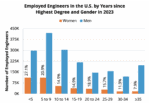
*Females as a percent of total within each Highest Degree category shown in figure
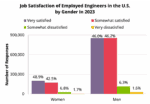
Despite the troubling findings on retention, women engineers who choose to stay in the sector report high levels of job satisfaction. In 2023, 91.4% of women in engineering jobs were satisfied with their careers. Only 8.5% of women engineers reported being dissatisfied with their job. There are almost no gender differences across job satisfaction levels of employed engineers in the United States.
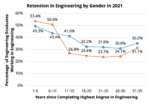
According to the NCSES, in 2021, 53.4% of women with engineering degrees who graduated within the last 1 to 5 years worked in engineering roles, compared to 49.3% of their male counterparts. However, this trend drops when examining the workforce retention rates for women who completed their degrees 11 to 15 years before 2021. In this instance, only 26.8% of women engineers continue in engineering jobs, compared to 41% of male engineers. The gender gap in engineering retention raises concerns about the underlying causes influencing women’s career paths.
Why Women Leave Engineering Careers
There are various reasons why women with engineering degrees are not working in engineering careers. According to the NCSES’ NSCG, in 2021, women with bachelor’s degrees in engineering reported the primary factors for leaving engineering occupations included a change in career interest, family-related considerations, and the absence of jobs in their highest degree field. Women with master’s or doctoral degrees left the engineering workforce for similar reasons. These include a shift in career interests, an apparent lack of pay or promotion opportunities, and family-related responsibilities. These reasons highlight the difficulties women in engineering can experience, requiring them to reconsider their career paths.
Keeping women in engineering is critical to fostering diversity, innovation, and equality. Employers can build an inclusive workplace that promotes creativity and innovative problem-solving by ensuring equal opportunities, challenging biases, and providing role models. Retaining women in engineering fuels economic growth, taps into a diverse skill pool, and drives progress in addressing global challenges. Adopting these goals is about fairness and shaping a more sustainable and equitable future for engineering and society.
SWE Efforts to Increase Female Representation in the Engineering and Computer Science Workforce
- SWE Public Policy
- SWE Legislative Action Center and Congressional Outreach
- SWE Studies on Gender Bias and Workplace Experiences
Resources
- National Center for Science and Engineering Statistics. (2023). National Survey of College Graduates.
- National Center for Science and Engineering Statistics. (2021). National Survey of College Graduates. Customized Table.