Bachelor's Degrees
NCES
Historically, fewer bachelor’s degrees in engineering and engineering technology are awarded to women than men. Overall, interest in these fields has grown, with more than 145,000 bachelor’s degrees in engineering and engineering technology awarded in the 2020-2021 academic year. In the last ten years, the number of women getting degrees more than doubled from 2011 (16,017) to 2021 (33,310). The percentage of women earning degrees increased from 2011 (17.2%) to 2021 (23.0%).

*Females as a percent of total shown in figure
Historically, fewer bachelor’s degrees in engineering are awarded to racial minority females than White females. In 2021-2022, out of the degrees awarded to women, 13.1% were awarded to Hispanic women and 5.4% to Black women.


ASEE
Data from the ASEE was used to rank the top bachelor’s degrees engineering disciplines awarded in 2024. According to their data, Computer Science in Engineering emerged as the leading discipline in number of degrees awarded to women (5,618), followed by Mechanical Engineering (4,999) and Biomedical Engineering (4,292). The table below provides more specific information on the distribution of degrees across engineering professions, providing valuable insights into gender equality within each engineering subject.
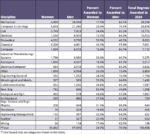
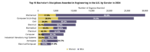
According to ASEE data for top ten bachelor’s disciplines awarded, Biomedical Engineering emerged as the discipline awarding the highest percentage to women (53.5%), followed by Chemical Engineering (42.1%), and Civil Engineering (34.8%). The chart below provides more specific information on the distribution of bachelor’s degrees by gender across the selected disciplines.
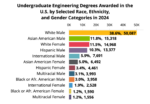
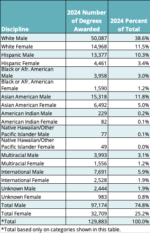
Data from ASEE show bachelor’s degrees awarded by race, ethnicity, and gender in 2024. According to their data, White students (50.1%) make up the largest racial group, followed by Asian students (16.8%). Black students (4.3%) comprise one of the lowest racial groups of degrees awarded in engineering. The chart and table below provides more specific information on the distribution of degrees across racial and gender categories. The percentages show the proportion of degrees issued to each category.
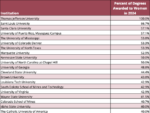
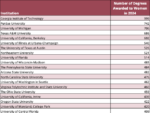
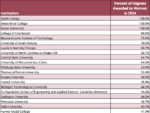
Data from the ASEE was used to rank the top 20 institutions by total number of bachelor’s degrees and percentage of bachelor’s degrees awarded to women in 2024. To view additional information on degrees awarded by institution, visit the Engineering Education Metrics Landscape Dashboard.
Master's Degrees
NCES
The number of engineering and engineering technology awarded at the master’s levels has increased from 2011 (9,807) to 2021 (15,260). The gender gap remains considerable, with women receiving only 28.5% of master’s degrees in engineering and engineering technology degrees in 2021.

*Females as a percent of total shown in figure
Historically, fewer master’s degrees in engineering are awarded to racial minority females than White females. In 2021-2022, out of the degrees awarded to women, 7.4% were awarded to Hispanic women and 3.4% to Black women.


ASEE
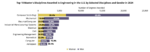
Data from the ASEE was used to rank the top master’s engineering disciplines awarded in 2024. According to their data, Computer Science in Engineering emerged as the leading discipline in number of degrees awarded to women (6,509), followed by Biomedical (1,809), and Industrial/Manufacturing/Systems (1,544). The table below provides more specific information on the distribution of degrees across the engineering disciplines, providing valuable insights into gender equality within each engineering subject.
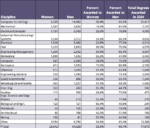
Data from ASEE was used to rank the top 10 master’s engineering disciplines awarded in 2024. According to ASEE data for top ten disciplines, Biomedical Engineering emerged as the discipline awarding the highest percentage to women (52.2%), followed by Engineering Management (34.9%) and Civil Engineering (30.0%). The chart below provides more specific information on the distribution of master’s degrees by gender across the selected disciplines.
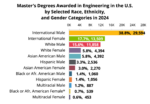
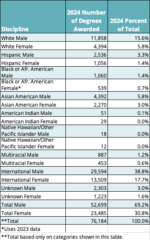
Data from ASEE show master’s degrees awarded by race, ethnicity, and gender in 2024. According to their data, International students (56.6%) make up the largest racial group, followed by White students (21.3%). Hispanic (4.7%) and Black students (2.1%) comprise one of the lowest groups of degrees awarded in engineering. The chart and table below provide more specific information on the distribution of degrees across racial and gender categories. The percentages show the proportion of degrees issued to each category.
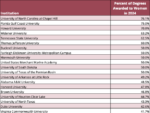
Data from the ASEE was used to rank the top 20 institutions by percentage of master’s degrees awarded to women in 2024. To view additional information on degrees awarded by institution, visit the Engineering Education Metrics Landscape Dashboard.
Doctoral Degrees
NCES
The number of engineering and engineering technology awarded at the doctoral level has increased from 2011 (1,877) to 2021 (2,910). The gender gap remains considerable, with women receiving 26.2% of engineering and engineering technology doctoral degrees in 2021.

*Females as a percent of total shown in figure
Historically, fewer doctoral degrees in engineering are awarded to racial minority females than White females. In 2021-2022, out of the degrees awarded to women, 4.5% were awarded to Hispanic women and 2.4% to Black women.


ASEE
Data from the ASEE was used to rank the top doctoral engineering disciplines awarded in 2024. According to their data, Biomedical engineering emerged as the leading discipline in number of degrees awarded to women (541), followed by Computer Science in Engineering (382), and Mechanical Engineering (362). The table below provides more specific information on the distribution of degrees across the engineering disciplines, providing valuable insights into gender equality within each engineering subject.
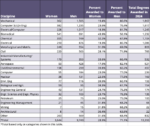
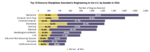
Data from the ASEE was used to rank the top ten doctoral engineering disciplines awarded in 2024. According to their data for top ten disciplines, Biomedical Engineering emerged as the discipline awarding the highest percentage to women (43.9%), followed by Civil/Environmental Engineering (39.8%) and Industrial/Manufacturing/Systems Engineering (33.6%). The chart below provides more specific information on the distribution of degrees across the selected disciplines.
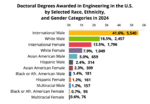
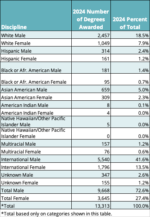
Data from ASEE show doctoral degrees awarded by race, ethnicity, and gender in 2024. According to their data, International students (55.5%) make up the largest racial group, followed by White students (24.6%). Hispanic (3.7%) and Black students (1.9%) comprise one of the lowest groups of degrees awarded in engineering. The chart and table below provides more specific information on the distribution of degrees across racial and gender categories. The percentages show the proportion of degrees issued to each category.
Data from the ASEE was used to rank the top 20 institutions by percentage of doctoral degrees awarded to women in 2024. To view additional information on degrees awarded by institution, visit the Engineering Education Metrics Landscape Dashboard.