
According to data from the National Center for Education Statistics (NCES) and the American Society for Engineering Education, (ASEE), female tenure/tenure-track faculty are not as well-represented at the highest levels of tenure when compared to their male counterparts in the United States.
Faculty by Rank, Discipline, and Years Since Doctorate
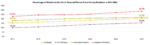
Over the years, there has been an increase in the percentage of women working in faculty tenured/tenure-track positions in the United States. Between 2014 and 2024, the percentage of women in these positions has grown, especially in assistant professor roles.
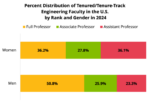
Data from the ASEE in 2024, showed a significant rank and gender disparity among engineering faculty. Among engineering male faculty members, 50.8% held positions as full professors, while only 36.2% of women faculty occupied similar roles. Furthermore, data indicated that 36.1% of women were employed as assistant professors, in contrast to 23.3% of their male counterparts. Overall, women accounted for 20.6% of all engineering faculty members.
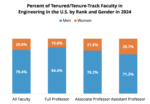
ASEE data in 2024 revealed an uneven distribution of roles within the academic rank structure, with 15.6% of full professors, 21.8% of associate professors, and 28.7% of assistant professors being women. The significance of rank in academia extends beyond titles; it significantly impacts salary and benefits, with full professors often enjoying greater financial rewards and professional privileges.
On average, only 21.2% of tenured/tenure-track faculty in U.S. engineering colleges are women. Biomedical Engineering (28.8%), followed by Mining Engineering (28.6%) and Environmental Engineering (27.5%) have the largest percentages of female tenured/tenure-track faculty, with over a quarter of their tenured/tenure-track faculty being female. Aerospace engineering has the lowest inclusion of female faculty, where less than 15% of their tenured/tenure-track faculty are female.
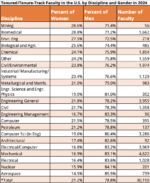
*Total does not include computer science (outside engineering)
In addition to being underrepresented in engineering faculty by rank, the gender gap widens over time based on when women earn their doctorate degrees. Data from the NCES in 2023 revealed that women who obtained their doctoral degrees within the last decade accounted for 29.7% in engineering and 48.5% in all science and engineering (S&E) fields. However, the numbers drop significantly for women who earned their doctorates ten years or more ago, with only 18.6% in engineering and 38.5% in all S&E fields. These statistics underscore the systemic challenges and barriers that women face in advancing their careers in STEM fields, indicating the need for targeted interventions and support mechanisms to address these disparities and ensure equitable representation across all career stages.

*Data suppressed to avoid disclosure of confidential information

*Data suppressed to avoid disclosure of confidential information
Faculty Salaries
The most recent NCSES Survey of Doctorate Recipients (2025) shows that in 2023, women’s median salary was equal to or more than that of their male counterparts in most engineering disciplines. In 2023, female full professors earned four thousand dollars more than male faculty with the same rank.


SWE Efforts to Increase Female Representation among Engineering and Computer Science Faculty
To address the need for more women in academic leadership positions in engineering and foster the professional growth of women in academia, SWE developed the Academic Leadership for Women in Engineering (ALWE) program. Participants in the ALWE program experience year-round workshops with interactive sessions that provide best practices to advance in academia while creating opportunities and mechanisms to network across institutions.
Resources
-
- American Society for Engineering Education. (2024). Engineering & Engineering Technology by the Numbers
- National Science Foundation, National Center for Science and Engineering Statistics, Survey of Doctorate Recipients, 2023